

Section 125 CrPC in BNSS: Now Section 144 and What Changed
Section 125 CrPC in BNSS is now Section 144 of the Bharatiya Nagarik Suraksha Sanhita, 2023. The BNSS replaced the Code of Criminal Procedure, 1973 on July 1, 2024. If you are searching for the old maintenance provision, this is where it now sits. The substance has largely carried over.
Section 144 BNSS lets a Magistrate of the first class order monthly maintenance for a wife, legitimate or illegitimate minor children, adult children with a disability, and parents. The person must have sufficient means and must have neglected or refused to maintain them. The wife cannot claim if she is living in adultery, refuses to live with her husband without sufficient reason, or lives separately by mutual consent. The provision continues to rely on the same test of means and neglect, now applied under the BNSS framework.
This article explains the text of Section 144 BNSS, who can claim and against whom, and how interim maintenance works. It then sets out the changes in wording and procedure from the old Section 125 CrPC. You will also see how Supreme Court rulings such as Rajnesh v. Neha (2020) on disclosure of assets continue to guide these proceedings. LeXi AI can help you trace such precedents quickly.
Why Section 144 BNSS matters after the CrPC repeal
Every maintenance petition filed on or after July 1, 2024 must cite Section 144 BNSS, not Section 125 CrPC. Section 531 BNSS repeals the Code of Criminal Procedure, 1973, so the old section number no longer works as a fresh filing. A petition that cites the repealed provision can usually be cured by amendment, but it invites an avoidable objection and delays interim relief for a wife, child, or parent who needs money now.
Which provision applies to your case
The date of filing decides the question. Section 531(2)(a) BNSS saves applications, appeals, trials, and inquiries that were pending on the day the new Sanhita came into force. Those continue under the CrPC as if the BNSS had not been enacted.
| Situation | Governing provision |
|---|---|
| Application filed on or after July 1, 2024 | Section 144 BNSS |
| Application pending on July 1, 2024 | Section 125 CrPC, through the savings clause in Section 531(2)(a) BNSS |
| Order already passed under Section 125 CrPC | Remains valid. The repeal does not wipe it out. |
Pay attention to one point when you advise a client. A husband who neglected his family in 2022 but is sued for the first time in 2025 faces a Section 144 BNSS petition. The date of the application, not the date of the neglect, picks the statute.
The date you file, not the date of neglect, decides whether Section 125 CrPC or Section 144 BNSS governs your petition.
Why the renumbering still affects your research
Most reported case law on maintenance speaks of Section 125 CrPC. That includes Mohd. Ahmed Khan v. Shah Bano Begum (1985) and Rajnesh v. Neha (2021). These rulings remain good authority because the core test of sufficient means and neglect has carried over into Section 144 BNSS. Section 8 of the General Clauses Act, 1897 also supports reading old references to the CrPC as references to the corresponding BNSS provision.
The Supreme Court showed this continuity in Mohd. Abdul Samad v. State of Telangana (2024), decided on July 10, 2024. It held that a divorced Muslim woman can seek maintenance under Section 125 CrPC, whatever her personal law says. The reasoning rests on the secular nature of the remedy, so you can cite it alongside Section 144 BNSS in fresh petitions.
In practice, search both numbers when you research. A query limited to "Section 144 BNSS" will miss most of the judgments you need, and a query limited to "Section 125 CrPC" will miss newer High Court orders. LeXi AI's judgment search can pull up decisions under either label, with verified sources, so you can build one list of authorities before you draft.
How to claim maintenance under Section 144 BNSS
Where to file and what to include
File a written application before a Magistrate of the first class. Section 145 BNSS lets you choose the district where the respondent lives, where he last lived with his wife, or, for an illegitimate child, with the child's mother. A wife, a parent, or an adult child with a disability applies directly. A minor child applies through the mother or a guardian.
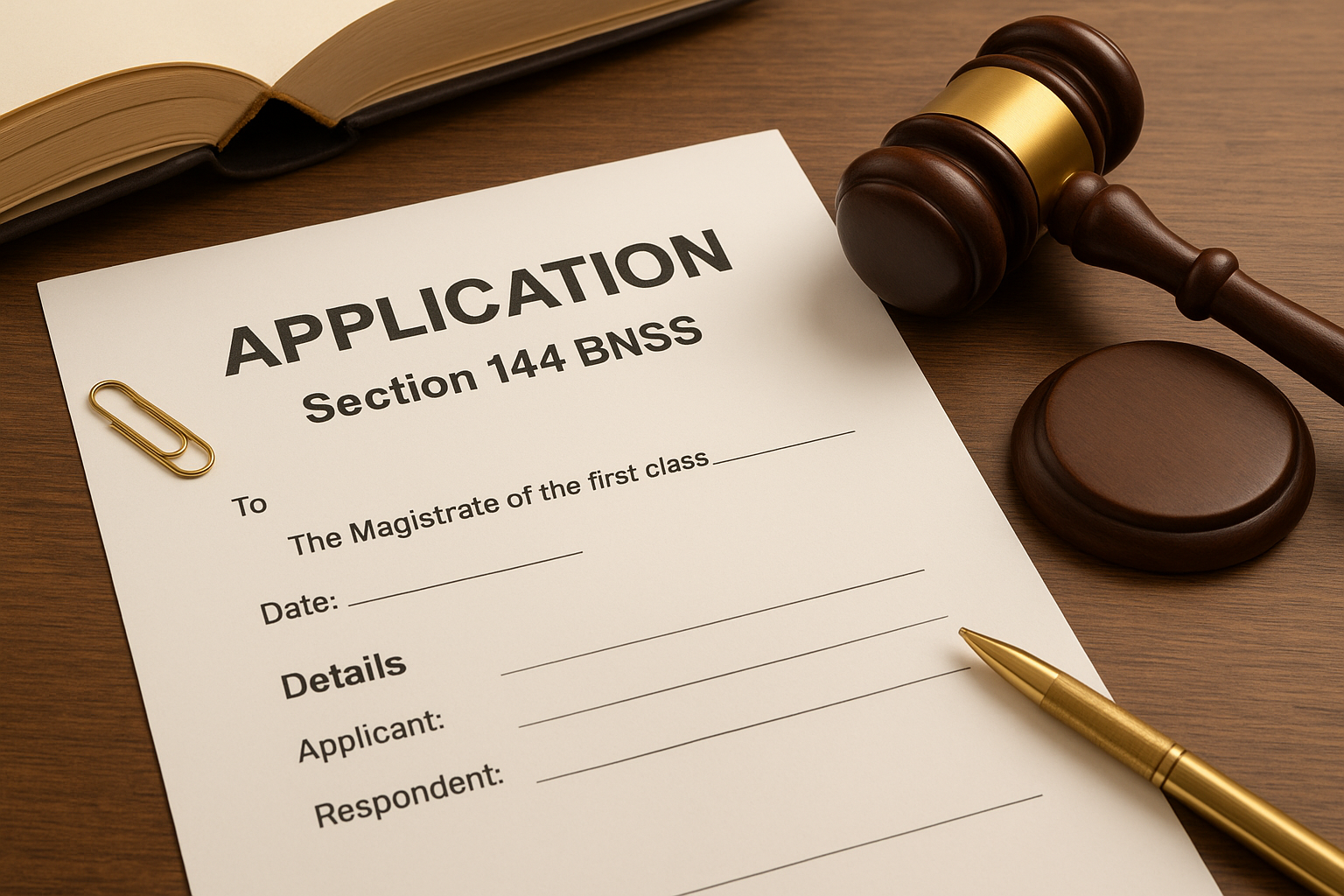
The procedure under Section 125 CrPC in BNSS form is the same in practice, with only the section number changed. Work through it in this order:
- Draft the application. State the relationship, the respondent's means, and the neglect or refusal.
- Attach an affidavit of assets, income, and liabilities, as Rajnesh v. Neha directs.
- Add proof of marriage or parentage, bank statements, salary slips, and records of your own expenses.
- Pray for interim maintenance and litigation expenses in the same application.
- Let the court serve notice, then lead evidence on both sides.
Interim maintenance and the sixty day timeline
Interim relief matters most, because a final order can take years. Section 144 BNSS allows the Magistrate to order a monthly interim allowance and the cost of the proceeding while the case is pending. The Magistrate should try to decide the interim application within 60 days of serving notice on the respondent. Courts often miss this timeline, so mention it in your prayer.
File the affidavit of assets with the application itself, because the Magistrate cannot fix a fair amount without it.
Expect the respondent to file a matching affidavit. Compare the two against bank records and income tax returns. Gaps between the declared income and the visible lifestyle are the strongest ground for a higher amount. If either side hides assets, the court can draw an adverse inference.
Finally, check the respondent's position before you file. The claim is against a person with sufficient means who has neglected or refused to maintain. A husband with a steady salary is a simple case. A self-employed respondent needs more documents, such as GST returns, property records, and loan applications. LeXi AI can summarize long financial exhibits so you can find the figures quickly.
What changed from Section 125 CrPC to Section 144 BNSS
Provisions that moved without a change in substance
Very little changed in substance. Parliament moved the maintenance chapter into the BNSS and renumbered it. The same claimants, the same test of means and neglect, and the same bars on a wife's claim were carried over. The related sections moved as well.
| CrPC section | BNSS section | Subject |
|---|---|---|
| 125 | 144 | Order for maintenance of wives, children, and parents |
| 126 | 145 | Venue, procedure, and recording of evidence |
| 127 | 146 | Alteration in the allowance |
| 128 | 147 | Enforcement of the order |
The meaning of "wife" still covers a divorced woman who has not remarried. The 60 day target for interim maintenance and the one year limit for recovering arrears also remain. Section 125 CrPC in BNSS form is therefore a renumbering, not a rewrite.
Section 144 BNSS restates Section 125 CrPC, so the settled case law on maintenance continues to apply.
Where the real differences appear
The differences sit around the section, not inside it. Section 530 BNSS allows proceedings, service of summons, and recording of evidence in electronic mode. A respondent working abroad can now be served and examined without long delays. This helps most when the husband lives in another city or country and avoids the court.
Be careful about what did not change. Section 144 still speaks of a "wife", and Parliament did not add live-in partners as a separate class. Courts have read the term generously, as in Chanmuniya v. Virendra Kumar Singh Kushwaha (2010), where the Supreme Court allowed a presumption of marriage for long cohabitation. Even so, plead marriage or its presumption with proof.
Finally, update your templates and notices. Replace every reference to Sections 125 to 128 CrPC with Sections 144 to 147 BNSS. Keep the old numbers in brackets when you cite older judgments, so the chain of authority stays clear to the court.
How courts fix the amount and when maintenance is refused
How does a court decide the monthly amount?
Courts work with no fixed ceiling. The old cap of Rs 500 was removed in 2001, and Section 144 BNSS does not bring it back. The Magistrate weighs the needs of the claimant against the paying capacity of the respondent. Rajnesh v. Neha lists the factors to examine:
- Status and standard of living of both sides
- Reasonable needs of the wife and dependent children, including school fees and medical costs
- Qualifications, employment, and independent income of the claimant
- Income, assets, and other liabilities of the respondent
- Litigation costs, and any illness or disability
A common benchmark is about 25% of the husband's net monthly salary, a figure traced to Dr. Kulbhushan Kumar v. Raj Kumari (1970) and cited in Rajnesh v. Neha. Treat it as a starting point, not a rule. Where the respondent supports several dependents, or the claimant has a high medical need, the figure moves up or down against his net monthly salary.
Earning capacity also counts, but with care. A qualified wife who is not working has not automatically lost her claim. Courts ask whether she actually earns enough to live in a manner close to her marital standard.
The amount follows the real income of the respondent and the real needs of the claimant, not the figures that appear on paper.
When does a court refuse maintenance?
Section 144 BNSS bars a wife's claim in three situations. These carry over unchanged when you read Section 125 CrPC in BNSS form:
- She is living in adultery.
- She refuses, without sufficient reason, to live with her husband.
- The couple live separately by mutual consent.
Refusal is not automatic, though. The husband must prove the bar with evidence, and a bare allegation of adultery is not enough. A second marriage, a mistress, or cruelty by the husband is a sufficient reason for the wife to live apart, so her separate residence does not defeat the claim.
Other claimants face their own tests. Parents and adult children with a disability must show that they cannot maintain themselves. A healthy adult child cannot claim at all. In every case, the respondent must have sufficient means, so a court will refuse an order against a person who has no income or assets, though it may still examine whether he is hiding them.
How to enforce or change a maintenance order
How do you enforce an unpaid order?
A maintenance order has value only when it is paid. Under Section 144(3) BNSS, the Magistrate can issue a warrant to levy the unpaid amount as if it were a fine. If a month's allowance still remains unpaid after the warrant, the respondent can be jailed for up to one month, or until he pays, whichever is earlier.
Section 147 BNSS helps when the respondent moves cities. You receive a copy of the order free of cost. Any Magistrate where the respondent now lives can enforce it once satisfied about his identity and the non-payment. Follow these steps:
- Obtain the certified copy of the order.
- Prepare a month-wise statement of arrears.
- File the recovery application within one year of each default.
- Ask for a warrant, and for imprisonment if the warrant fails.
Apply for recovery within one year of each missed payment, because the court cannot issue a warrant for older arrears.
Maintenance runs from the date of the order, unless the court directs otherwise. Following Rajnesh v. Neha, ask for it from the date of the application, so the months spent in litigation are covered.
How do you change or cancel an order?
Section 146 BNSS lets the Magistrate alter the allowance when circumstances change. Either side can apply, but you must prove the change with documents. A fresh salary slip, a termination letter, or a medical bill will carry more weight than a bare statement.
| Ground | Likely result |
|---|---|
| Respondent's income rises or the claimant's needs grow | Allowance increased |
| Respondent loses his job or falls seriously ill | Allowance reduced |
| Divorced wife remarries | Order canceled |
| Wife received the full sum due under personal law or custom on divorce | Order canceled |
| Wife voluntarily gave up her right | Order canceled |
| Wife found living in adultery, or living apart without sufficient reason or by mutual consent | Order canceled under Section 144(5) |
A civil court decree on the same dispute can also matter. If it gives the wife a sum that covers her maintenance, the Magistrate must cancel or vary the order accordingly. Keep every payment receipt, since the respondent will use any gap in your records to seek a reduction.
How Section 144 BNSS works alongside other maintenance laws
Can you claim under more than one law?
Yes. Section 144 BNSS is a summary criminal remedy, and it does not displace the civil and personal law rights a claimant already holds. Section 125 CrPC in BNSS form therefore sits beside several other statutes, and a petitioner can often use more than one.
| Law | Forum | Who it helps |
|---|---|---|
| Hindu Adoptions and Maintenance Act, 1956 (Sections 18 and 20) | Family Court or civil court | Hindu wife, children, parents |
| Hindu Marriage Act, 1955 (Sections 24 and 25) | Matrimonial court | Either spouse, during and after the case |
| Protection of Women from Domestic Violence Act, 2005 (Section 20) | Magistrate | Wife or woman in a domestic relationship |
| Muslim Women (Protection of Rights on Divorce) Act, 1986 (Section 3) | Magistrate | Divorced Muslim woman |
| Maintenance and Welfare of Parents and Senior Citizens Act, 2007 (Section 4) | Maintenance Tribunal | Parents and senior citizens |
Section 36 of the Domestic Violence Act states that its reliefs are in addition to, and not in derogation of, any other law. Section 26 of the same Act also lets a woman seek those reliefs in other pending proceedings. Neither law shuts the door on the other.
How do courts avoid double payment?
In Rajnesh v. Neha, the Supreme Court directed that every party disclose earlier and pending maintenance claims in the affidavit of assets. A court that has already received such a disclosure must adjust, or set off, the amount awarded in the first proceeding against the later one. The claimant therefore receives one fair sum, not two.
Claim under every law that fits, but disclose each claim, because courts adjust the amounts instead of ordering payment twice.
Choose the forum by speed and by the relief you need. A parent who wants quick relief against a son may prefer the Tribunal under the 2007 Act, while a wife who also faces violence at home gains more from a Domestic Violence Act petition, which can add residence orders. Whatever route you pick, keep one consolidated statement of all orders and payments, so you can show each court what has already been awarded.
Key points to remember
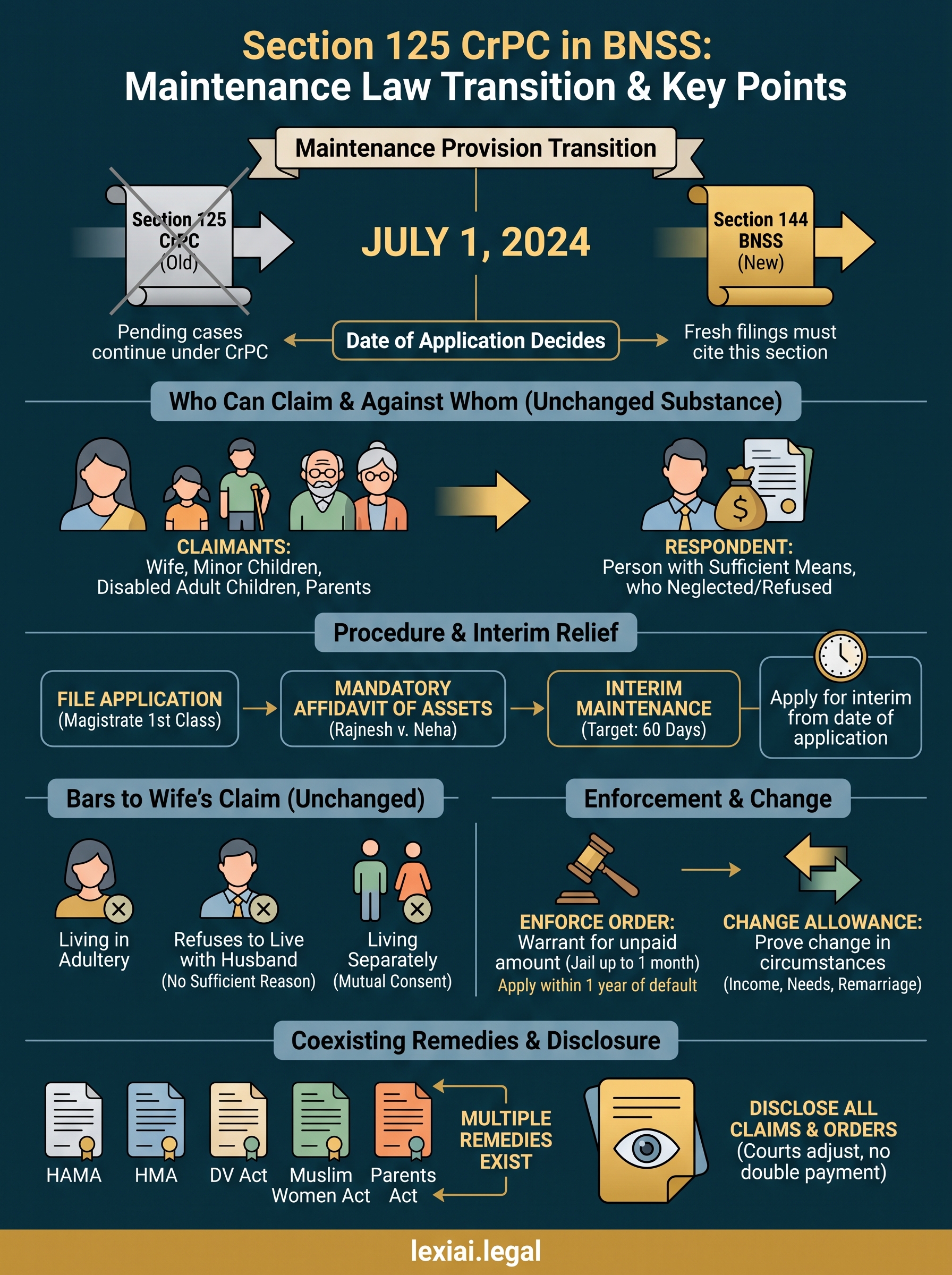
Section 125 CrPC in BNSS is now Section 144, and the change is mostly a renumbering. The date of filing decides which provision governs your case. Cite Section 144 BNSS in every fresh petition, and keep the old numbers in brackets when you rely on earlier judgments.
Claimants remain the wife, minor children, adult children with a disability, and parents. The test is still sufficient means and neglect, and the amount follows the real income and real needs of both sides. File the affidavit of assets with the application and ask for interim maintenance at the start.
Enforcement has a clock. Seek recovery within one year of each default, and apply under Section 146 BNSS when circumstances change. Other laws, such as the Domestic Violence Act, sit beside Section 144, so disclose every claim you have made.
When you prepare these petitions, you will need to trace precedents under both section numbers and read long financial records. You can test LeXi AI free on your next maintenance petition to search judgments and draft your application faster.