

RTI Application Format: How to Draft and File One
An RTI application format does not need to be complicated. Section 6(1) of the Right to Information Act, 2005 does not prescribe a mandatory form for most states, so a simple letter addressed to the Public Information Officer, stating your request clearly, is legally sufficient. What matters is including the right details in the right order, not fancy legal language.
If you are drafting one right now, the answer is straightforward: write the PIO's name and department, state your specific information request in numbered points, mention the fee payment method, and sign with your address. Some states like Maharashtra and Delhi do have prescribed forms (Form A), so checking your state rules first saves a rejection later. This article gives you a ready-to-use template along with the exact filing steps.
Below, I walk through a full sample application, the mandatory fields under Section 6(3), how to calculate the Rs. 10 fee, and where to file depending on whether you are approaching a central or state authority. For lawyers drafting RTIs on behalf of clients regularly, LeXi Desk and the wider LeXi AI workspace can also speed up repetitive drafting and clause checks, though the format itself remains simple enough to do by hand.
What should a valid RTI application format include
A valid RTI application format needs five elements: the name and address of the Public Information Officer, your own name and address, a clear statement of the information sought, proof of fee payment, and your signature with date. Section 6(3) of the Act and the RTI Rules, 2012 do not prescribe a specific font, paper size, or word count, so a typed letter and a handwritten one carry equal weight, as long as these fields are present. Leaving out even one item, such as the fee reference number, gives the PIO a technical reason to return your application without processing it.
A missing fee proof is the single most common reason a genuine RTI application gets bounced back.
Mandatory fields under Section 6(3)
Check your draft against this list before you post it or upload it online:
- PIO's designation and full office address
- Your name, postal address, and phone number
- A subject line reading "Application under the Right to Information Act, 2005"
- Numbered, specific queries (avoid open-ended requests like "provide all details")
- Fee payment mode, amount, and reference number
- A one-line declaration that you are a citizen of India
- Your signature and the date
Why generic requests get rejected
PIOs are not obligated to compile analysis, opinions, or explanations under Section 2(f), which defines "information" narrowly as material already held in some record form. Asking "why did the municipal corporation delay my file" invites a rejection, while asking "provide the file movement register entries for application number 4521 between January and March 2026" gets you an actual answer. This distinction between seeking records and seeking reasoning is where most first-time applicants lose weeks to back-and-forth correspondence with the public authority.
Step 1. Identify the right Public Information Officer
Finding the correct PIO decides whether your application reaches the right desk or gets transferred under Section 6(3), which quietly adds weeks to your wait. Start by checking whether the information falls under a central government body, a state department, or a public sector undertaking, since each maintains its own Public Information Officer and first appellate authority. Government websites, RTI online portals, and departmental citizen charters usually list the PIO's name, designation, and office address.
Filing with the wrong PIO does not void your application, but it does cost you time you cannot get back.
Verify these details before addressing your letter:
- Full name and designation of the PIO, not just "PIO, Department of X"
- Complete postal address, including pin code
- Whether the department follows central RTI Rules or a state-specific RTI application format
- Whether your local post office accepts applications as an Assistant Public Information Officer on the department's behalf
For central government bodies, the RTI Online portal lists PIOs ministry-wise, which saves a phone call to the department's front desk before you draft anything.
Step 2. Draft your RTI application in the prescribed format
Now that you have the correct PIO, write the actual letter using plain, numbered language. Keep each query to one fact you want, not a bundle of three questions disguised as one, since PIOs often answer only the first line and ignore the rest.
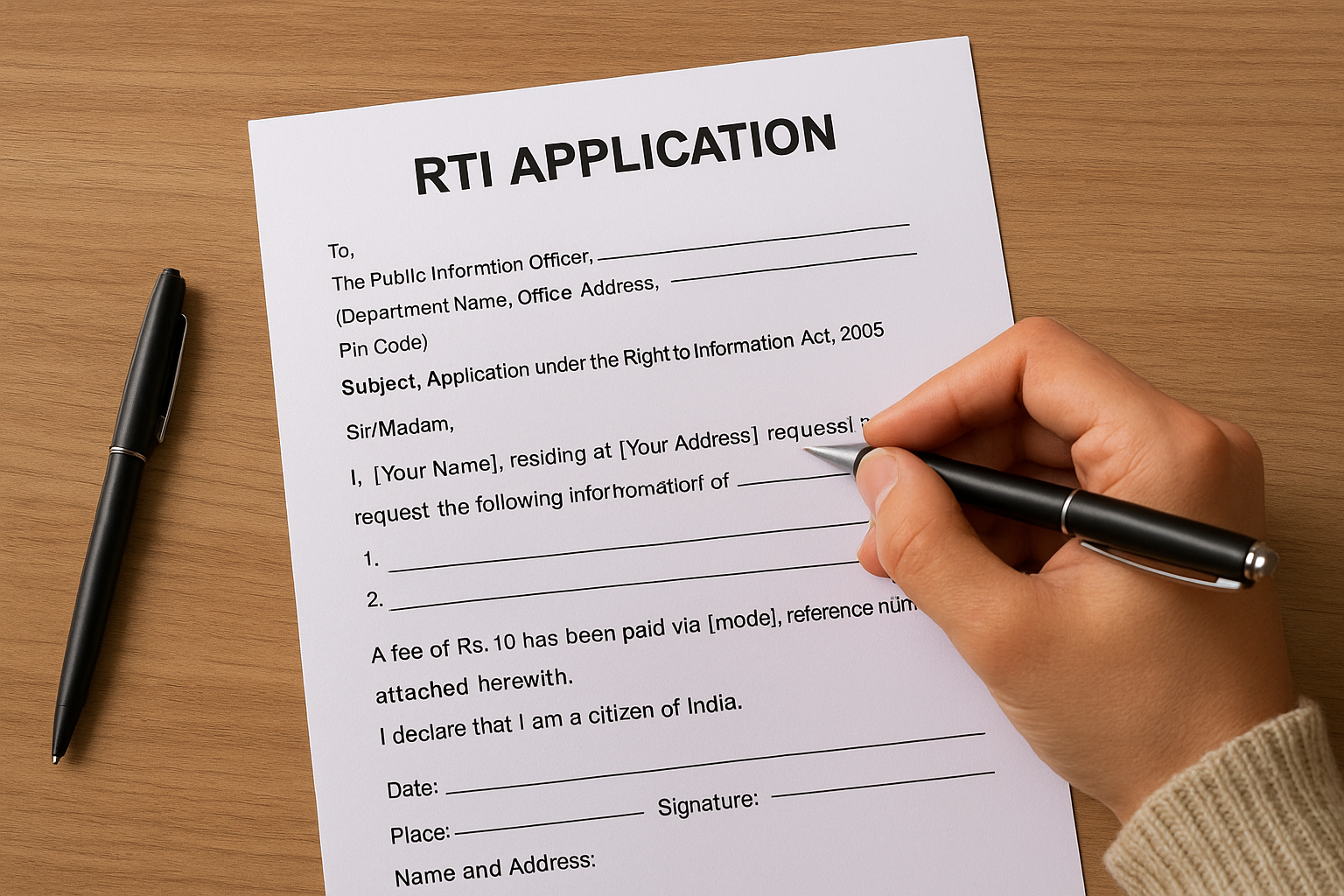
A clear, numbered RTI application gets a clear, numbered answer.
Copy this RTI application template and fill in your own details:
To,
The Public Information Officer,
[Department Name, Office Address, Pin Code]

Subject: Application under the Right to Information Act, 2005

Sir/Madam,

I, [Your Name], residing at [Your Address], request the following information under Section 6(1) of the RTI Act, 2005:

1. [Specific query one]
2. [Specific query two]

A fee of Rs. 10 has been paid via [mode], reference number [XXXX], attached herewith.

I declare that I am a citizen of India.

Date:
Place:
Signature:
Name and Address:
Underneath the queries, mention the time period and department involved, since vague dates force the PIO to search multiple years of records. Firms handling volume filings often use LeXi Desk and similar AI legal drafting tools used in India to auto-fill repetitive fields like department names and reference formats, cutting drafting time without changing the legal structure above.
Step 3. Attach the application fee and proof of payment
Pay the application fee before you post or upload your RTI, since an unpaid application is legally treated as incomplete under Rule 3 of the RTI Rules, 2012. Central government applications require Rs. 10, payable by postal order, demand draft, or through the RTI Online portal's payment gateway. Applicants who fall Below Poverty Line are exempt from this fee entirely, provided they attach a valid BPL certificate copy.

No fee proof means no processing, regardless of how well the queries are drafted.
Check which payment mode your target department accepts before you draft the letter:
| Payment Mode | Accepted By | Proof to Attach |
|---|---|---|
| Indian Postal Order | Central departments, most states | Original IPO number and date |
| Court fee stamp | State departments (varies) | Stamp affixed on application |
| Demand draft/banker's cheque | Larger PSUs, ministries | DD number, bank, date |
| Online payment | RTI Online portal | Transaction ID printed on form |
State-run departments sometimes only accept court fee stamps, so a quick call to the PIO's office before filing saves a returned envelope two weeks later.
Step 4. Submit and track your RTI application
Once your letter and fee proof are ready, choose your filing route: registered post, hand delivery against an acknowledgment receipt, or the RTI Online portal for central government bodies. Keep a photocopy of the entire application, including the fee proof, before you send it, since you will need those reference numbers later.
An RTI application without a tracking number is an application you cannot follow up on.
After filing, note these three checkpoints:
- The PIO must respond within 30 days under Section 7(1), or 48 hours if the request concerns life or liberty
- If filing online, save the registration number generated after payment confirmation
- If filing by post, keep the postal receipt as your only proof of the filing date
If 30 days pass with no reply, or you receive a rejection you find unfair, file a first appeal with the appellate authority named on the department's website, within 30 days of the deadline lapsing. Lawyers managing multiple RTI filings for clients often track these deadlines inside LeXi Desk or another case and deadline tracking platform for law practices, since missed appeal windows are harder to fix than a drafting error.
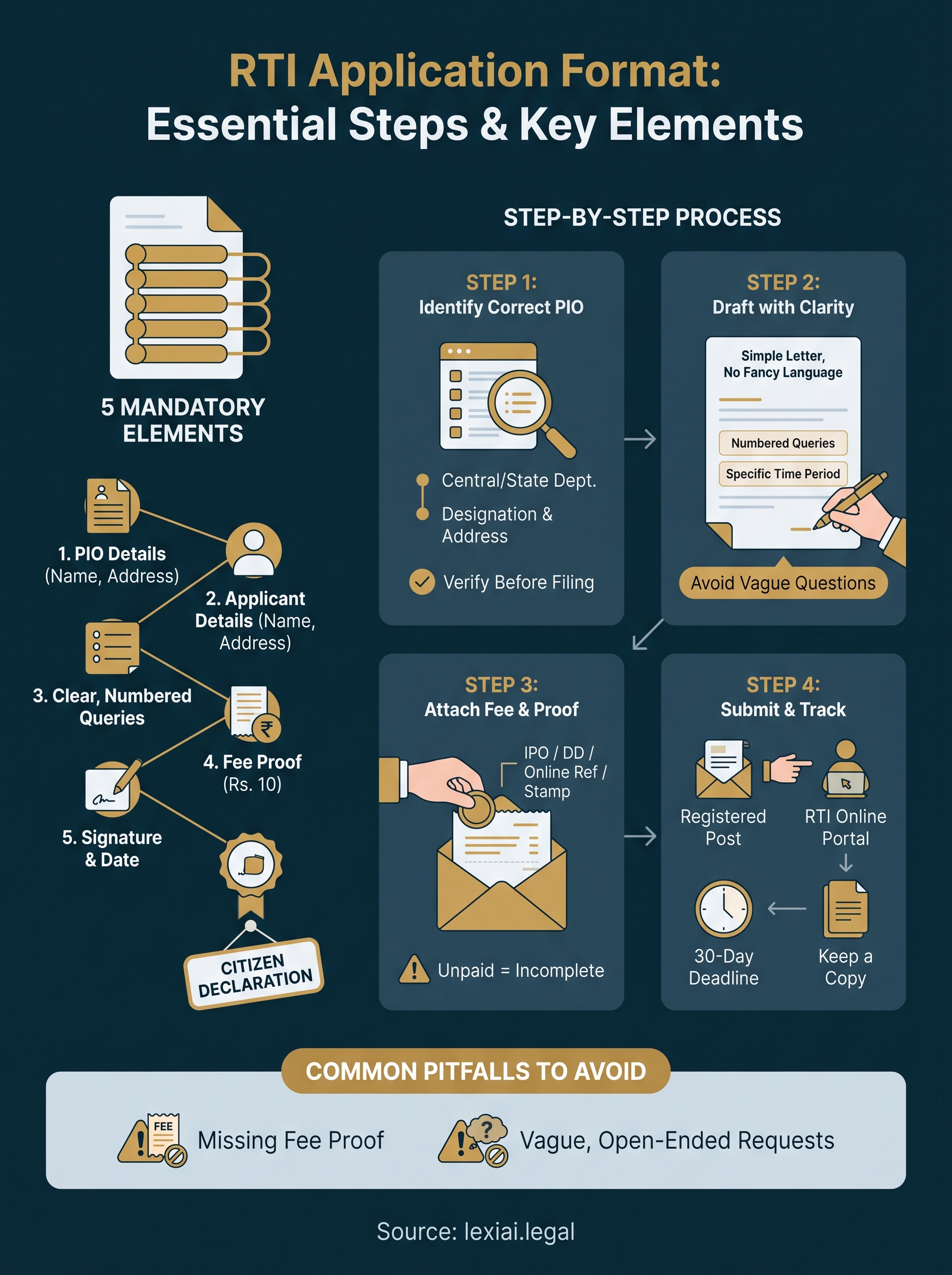
Getting your RTI request right the first time
A correct RTI application format comes down to five things: the right PIO, numbered specific queries, proof of fee payment, your signature, and a copy kept for your own records. Skip any one of these, and you risk a returned application or weeks of avoidable delay. Most rejections have nothing to do with the information itself and everything to do with a missing reference number or a vague question that reads like an opinion request.
Once you have filed a few applications, the drafting becomes routine, though tracking deadlines across multiple filings still eats up time for lawyers handling this at volume. That is where a platform built for legal drafting and case tracking earns its place in your workflow. If you file RTIs regularly for clients or your own practice, test LeXi AI free on your next RTI filing and see how much of this repetitive drafting and deadline tracking it can take off your plate.