

LLP Agreement Format: Draft It and File Form 3 in India
The standard LLP agreement format follows a fixed order: parties and recitals, name, business and office, contributions, profit sharing, partners and designated partners, management, exit and disputes, then signatures. You print it on stamp paper, get every partner to sign it, and file it in e-Form 3 on the MCA portal within 30 days of incorporation. The steps below give you the clause order and model wording for each part.
Many new LLPs go wrong in one of two ways. Some skip the agreement, and Schedule I of the Limited Liability Partnership Act, 2008 then fills the gaps with equal profit shares, no partner remuneration and no power to expel a partner. Others copy a template written for a different LLP and file it with another firm's name, an unrelated city for arbitration, or a remuneration clause that fails the tax conditions for a deduction.
This guide covers five drafting and filing steps, with clauses you can adapt, and ends with a checklist. LeXi AI builds contract drafting and clause review tools for Indian legal professionals, so the guide reads the way a drafting desk reads an agreement. It asks what the Act allows, what each clause does, and where the risk sits. Use it as a working format, and have a practicing lawyer or Chartered Accountant review the final text.
What is an LLP agreement and why does the format matter?
An LLP agreement is the written contract between the partners, or between the LLP and its partners, that records their rights and duties under Section 23 of the LLP Act, 2008. The LLP agreement format matters for two reasons. The agreement must be filed with the Registrar, and anything you leave out is decided for you by the default rules in Schedule I.
What the Act requires
Section 23 says the mutual rights and duties of the partners, and of the LLP and its partners, are governed by the agreement. The agreement and every later change must be filed with the Registrar. For a new LLP, that means e-Form 3 within 30 days of incorporation, and the Registrar charges an additional fee of Rs. 100 per day for delay.
You can sign the agreement before incorporation, but it binds the LLP only if all partners ratify it after incorporation. Signing after you receive the Certificate of Incorporation is simpler. The recitals can then carry the LLPIN and the incorporation date, which keeps the filing consistent.
What Schedule I provides when you have no agreement
Schedule I applies when no agreement exists, and it also fills any matter your agreement does not cover. The table shows the defaults that cause the most disputes.
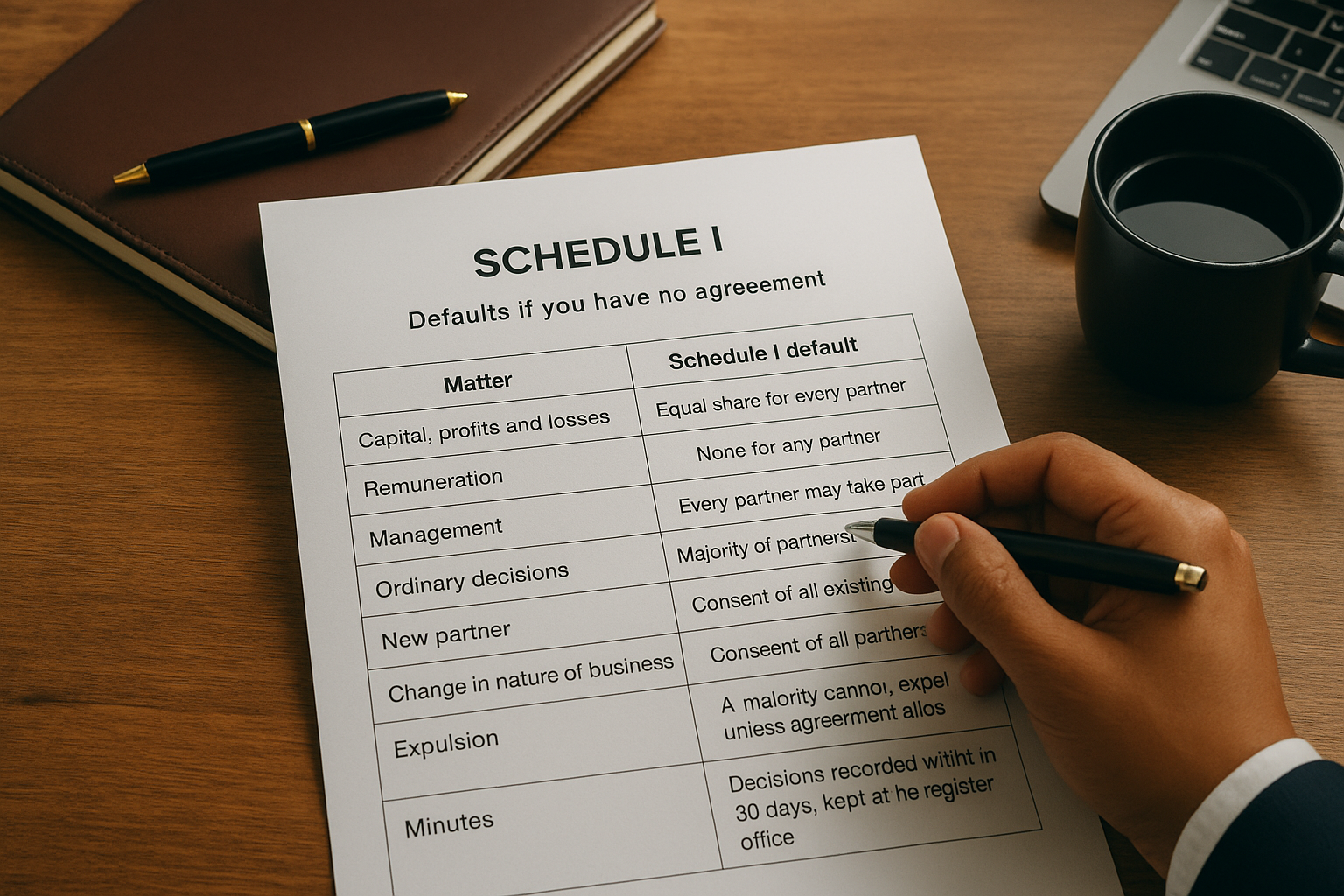
| Matter | Schedule I default | Why most LLPs change it |
|---|---|---|
| Capital, profits and losses | Equal share for every partner | Partners rarely invest equally |
| Remuneration | None for any partner | Working partners expect pay, and a tax deduction needs a clause |
| Management | Every partner may take part | Day-to-day control usually sits with designated partners |
| Ordinary decisions | Majority of partners, one vote each | Votes should follow a stated rule |
| New partner | Consent of all existing partners | Often kept, but the agreement should say so |
| Change in nature of business | Consent of all partners | Usually kept |
| Expulsion | A majority cannot expel unless the agreement allows it | Exit rules are needed |
| Minutes | Decisions recorded within 30 days, kept at the registered office | Usually kept |
Schedule I is a safety net and not a business plan, and its defaults rarely match the deal the partners actually made.
What to gather before you start
Collect these details first, because the drafting stalls without them:
- LLP name and LLPIN from the Certificate of Incorporation
- Registered office address
- Each partner's full name, age, address, PAN and DIN
- The amount and form of each partner's contribution
- The profit and loss ratio
- A one-line description of the business
- Names of at least two designated partners
Section 6 requires at least two partners. Section 7 requires at least two designated partners who are individuals, and at least one must be resident in India. Resident means a person who stayed in India for 182 days or more in the preceding year.
Step 1. Draft the preamble, name, business and office clauses
Begin with the clauses that identify the LLP and the people behind it: date and place of signing, parties, recitals, definitions, name, business and registered office. These clauses look routine, but this part of the LLP agreement format must match the incorporation records exactly, or the filing can be sent back.
Write the parties, recitals and definitions
Name each partner by the full legal name on the PAN card, with age, address, PAN and DIN. For a body corporate partner, give its CIN or registration number and registered office, and name the individual who will act as its nominee. Leftover details from a source template, such as another person's age or a different city, are the most common error here.
The recitals state two facts. First, the LLP was incorporated under the Act with a given LLPIN on a given date. Second, the partners are recording their terms under Section 23. Keep the definitions short and define only terms you use, such as Act, Contribution, Designated Partner, Financial Year, LLP and Partner. An unused definition only invites argument.
Fix the name, business and registered office clauses
Copy the name exactly as it appears in the Certificate of Incorporation, including the word LLP or the words Limited Liability Partnership. Describe the main business in a sentence, then add a clause for any other lawful business that all partners approve. A broad object saves you an amendment later, and a rule that no change in the nature of business needs all partners' consent mirrors Schedule I.
State the registered office as it stood at incorporation. The Registrar must be told about any change of registered office, so the clause should say who approves the change. Unanimous consent is the usual choice.
LIMITED LIABILITY PARTNERSHIP AGREEMENT

This Agreement is made at [city] on [date] between:
(1) [Full name], aged [age], residing at [address], PAN [PAN], DIN [DIN] ("Partner 1"); and
(2) [Full name], aged [age], residing at [address], PAN [PAN], DIN [DIN] ("Partner 2").

RECITALS
A. [Name of LLP] was incorporated on [date] under the Limited Liability Partnership Act, 2008, with LLPIN [LLPIN].
B. The Partners wish to record their mutual rights and duties under Section 23 of the Act.

1. NAME. The name of the LLP is [Name of LLP], as stated in its Certificate of Incorporation.

2. BUSINESS. The LLP shall carry on the business of [describe main business] and any other lawful business that all Partners approve in writing. No change in the nature of the business shall be made without the written consent of all Partners.

3. REGISTERED OFFICE. The registered office of the LLP is at [address]. The Partners may change it by unanimous consent, and the LLP shall notify the Registrar as the Act requires.
Every identifying detail in the agreement must match the Certificate of Incorporation, character for character.
Step 2. Record contributions, profit sharing and remuneration
State what each partner puts in, in rupees and in kind. Then fix profit and loss ratios that add up to 100 percent, and add remuneration and interest clauses if you want the LLP to claim a tax deduction. These clauses cause most partner disputes, so an LLP agreement format should use numbers and formulas here, not general words.
Set out contributions
The Act defines contribution widely. It can be cash, movable or immovable property, tangible or intangible assets, a promise to contribute, or services. The Act sets no minimum contribution, so the amount is a commercial decision. Record the value and date for any non-cash contribution, because a later valuation dispute is hard to settle without them.
A schedule to the agreement keeps the figures in one place. The numbers below are illustrative.
| Partner | Contribution | Form | Profit share | Loss share |
|---|---|---|---|---|
| Partner 1 | Rs. 3,00,000 | Cash | 60% | 60% |
| Partner 2 | Rs. 2,00,000 | Software licenses, valued by agreement | 40% | 40% |
Add clauses for additional capital, interest on capital, drawings and partner loans. Additional capital should need written consent, or follow a stated ratio. Under the Act, a partner is not personally liable for the LLP's obligations only because of being a partner, but liability for a partner's own wrongful acts or fraud remains.
Fix profit and loss ratios
The profit ratio does not have to match the capital ratio. Many LLPs give a working partner a larger share than the capital alone would earn. State the ratio in percentages, say that net profit is computed after expenses and taxes at the financial year end, and say when distribution happens.
State the loss ratio separately, even when it equals the profit ratio. If the agreement is silent, Schedule I applies and every partner shares equally, which surprises partners who invested unequally.
Draft remuneration and interest for tax deduction
Section 40(b) of the Income-tax Act, 1961 treats an LLP like a firm. It allows a deduction for interest to partners up to 12 percent simple interest per year, and for remuneration to working partners only if the agreement authorizes it. The authorization must be in writing and must not relate to any period before the date of the agreement.
The remuneration deduction is capped by book profit:
- On the first Rs. 3,00,000 of book profit, or on a loss, the higher of Rs. 1,50,000 or 90 percent of book profit
- On the balance of book profit, 60 percent
From tax year 2026-27, the Income-tax Act, 2025 replaces the 1961 Act. Draft the clause by reference to "the Income-tax Act in force" and do not hard-code a section number. State the amount of remuneration, or the formula for it, for each working partner.
4. CONTRIBUTION. The contribution of each Partner is set out in Schedule A. A non-cash contribution shall be recorded at the value agreed by all Partners on the date of this Agreement. Additional contribution shall be made only with the written consent of all Partners.

5. PROFITS AND LOSSES. The net profit of each financial year, after all expenses and taxes, shall be shared in the ratio of [60:40]. Losses shall be borne in the ratio of [60:40].

6. REMUNERATION AND INTEREST. Each working Partner shall receive remuneration of Rs. [amount] per month, or as computed by [formula], with effect from the date of this Agreement and within the limit allowed for deduction under the Income-tax Act in force. The LLP shall pay simple interest at [12] percent per annum on each Partner's capital and on loans from Partners.

7. DRAWINGS. A Partner may draw from the LLP up to Rs. [amount] per month against that Partner's profit share, with the written consent of all Partners for any larger sum.
A remuneration clause with no amount and no formula gives the LLP no safe basis for a tax deduction.
Step 3. Appoint partners and set the management rules
Name the designated partners, say who can bind the LLP and up to what limit, and set a voting rule for each kind of decision. The management clause in any LLP agreement format decides whose signature a bank, the Registrar or a counterparty will accept, so it deserves the most care.

Name the designated partners
Section 7 requires at least two designated partners who are individuals, and at least one must be resident in India. If a body corporate is a partner, its nominee can act as a designated partner. Each designated partner must hold a DIN and must consent to act.
Section 8 makes designated partners responsible for the LLP's compliance with the Act, and liable to penalties for default. The agreement should record their consent and their duty to make annual filings and file changes on time. It should also say that a partner whose failure causes a penalty reimburses the LLP.
Set voting, meetings and accounts
Schedule I lets every partner take part in management and lets a majority, one vote each, decide ordinary matters. Few businesses want that rule. Decide whether votes count per head or by capital, and list the reserved matters that need every partner's consent. The table shows a workable starting point.
| Decision | Suggested approval |
|---|---|
| Day-to-day operations and routine contracts | Designated partners, within stated limits |
| Operating a bank account | One designated partner up to a limit, two jointly above it |
| Borrowing or giving a guarantee | All partners |
| Selling or mortgaging LLP property | All partners |
| Admitting a new partner | All existing partners |
| Changing the business or the agreement | All partners, in writing |
For meetings, fix a notice period, a quorum and a venue. Allow a written resolution signed by all partners. Schedule I requires decisions to be recorded in minutes within 30 days and kept at the registered office.
Add an accounts clause for the financial year, the books and the audit. Rule 24 of the LLP Rules, 2009 requires an audit when turnover exceeds Rs. 40 lakh or contribution exceeds Rs. 25 lakh.
Admit new partners correctly
Section 24 lets an individual or a body corporate become a partner as the agreement provides. Section 25 requires the LLP to notify the Registrar of a change in partners within 30 days, using Form 4. The clause should require the new partner's written consent and the existing partners' consent. It should also say that the contribution and profit share are agreed at admission, and that the agreement will be amended and refiled.
8. DESIGNATED PARTNERS. [Name] and [Name] are the Designated Partners. Each holds a DIN and has consented to act. At least one Designated Partner shall be resident in India at all times. A Partner whose default causes a penalty on the LLP shall reimburse the LLP.

9. MANAGEMENT. The day-to-day affairs of the LLP shall be managed by the Designated Partners. The following require the written consent of all Partners: (a) borrowing above Rs. [amount]; (b) any guarantee; (c) sale or mortgage of LLP property; (d) admission of a new Partner; (e) any change in the nature of the business.

10. MEETINGS. Seven days' written notice shall be given for a meeting of Partners. Decisions shall be recorded in minutes within 30 days and kept at the registered office. A resolution signed by all Partners is as valid as one passed at a meeting.

11. BANK ACCOUNTS. Any one Designated Partner may operate the LLP's bank account up to Rs. [amount]. Two Designated Partners shall sign jointly above that amount.

12. ACCOUNTS. The financial year of the LLP is 1 April to 31 March. Books of account shall be kept at the registered office and audited as the Act and the Rules require.

13. NEW PARTNERS. A person may be admitted as a Partner only with the written consent of all existing Partners and that person's own written consent. The contribution and profit share of a new Partner shall be fixed at admission, and this Agreement shall be amended accordingly.
Decide now whose signature binds the LLP, because the bank and the Registrar will ask later.
Step 4. Add exit, dispute and winding-up clauses
Write the exit clauses before anyone wants to leave. Cover retirement notice, expulsion, death, transfer of interest, a dispute process, winding up and amendments. Partners read these clauses only during a conflict, so this part of the LLP agreement format must be specific enough to apply without argument.
Retirement, expulsion and death
Section 24 lets a person cease to be a partner as the agreement provides. A retirement clause needs a written notice period, an accounting date and a payment timeline. Thirty days' notice is common, but you choose the period.
Without an express clause, a majority cannot expel a partner under Schedule I. If you want an expulsion power, list the grounds, such as breach of the agreement, insolvency or running a competing business. Then add a notice, a chance to remedy, and the vote of the remaining partners.
The LLP has perpetual succession, so a death or exit does not dissolve it. State that the legal heirs receive the capital account balance, and that a nominee can be admitted only with the remaining partners' consent. Fix the valuation method now, either book value or an independent valuer.
Transfer of interest
A partner can transfer the right to a share of profits, wholly or partly. The transferee does not become a partner and gets no management rights. Many agreements add a right of first refusal, under which the exiting partner offers the interest to the other partners for a fixed period before selling outside.
Dispute resolution
Use a stepped clause. Start with a written notice of dispute and 30 days of negotiation, then refer the matter to arbitration under the Arbitration and Conciliation Act, 1996. Name the seat of arbitration, the number of arbitrators and the language.
The seat matters. In Indus Mobile Distribution Pvt. Ltd. v. Datawind Innovations Pvt. Ltd. (2017) 7 SCC 678, the Supreme Court held that when parties designate a seat, the courts of that seat have exclusive jurisdiction. Choose a city you can actually reach, and not the city that appeared in a sample.
Winding up and amendments
State the approval needed to start voluntary winding up. State also the order in which assets are applied: creditors first, then partners' contributions, then any surplus in the profit ratio. For amendments, require a written supplemental agreement signed by all partners, and file it in Form 3 within 30 days.
14. RETIREMENT. A Partner may retire by giving 30 days' written notice. Accounts shall be taken as on the date of retirement, and the amount due shall be paid within [90] days.

15. EXPULSION. A Partner may be expelled by the other Partners for [list grounds], after written notice and [30] days to remedy the breach.

16. DEATH. On the death of a Partner, the LLP shall continue. The legal heirs shall receive the balance in the Partner's capital account, valued as at the date of death by [method]. A nominee may be admitted only with the written consent of the remaining Partners.

17. TRANSFER. A Partner who wishes to transfer a profit interest shall first offer it to the other Partners for [30] days. A transferee shall not become a Partner or take part in management without admission under Clause 13.

18. DISPUTES. Any dispute shall first be notified in writing and discussed for 30 days. If unresolved, it shall be referred to a sole arbitrator under the Arbitration and Conciliation Act, 1996. The seat of arbitration shall be [city], the language shall be English, and the courts at [city] shall have exclusive jurisdiction.

19. WINDING UP. The LLP may be wound up voluntarily only with the written consent of [all] Partners. On winding up, the assets shall be applied first to creditors, then to Partners' contributions, and any surplus shall be shared in the profit ratio.

20. AMENDMENT. This Agreement may be amended only by a written supplemental agreement signed by all Partners and filed with the Registrar within 30 days.
Exit clauses are the ones partners rely on when they have stopped agreeing, so write them while everyone still does.
Step 5. Stamp, sign and file Form 3 within 30 days
Print the agreement on stamp paper of the correct value for your state and have every partner sign it. Then scan it and file it in e-Form 3 on the MCA portal within 30 days of incorporation. A designated partner signs the form digitally, and the Registrar's acknowledgment is your proof that the LLP agreement format you drafted was filed.
Pay stamp duty and sign
Stamp duty is a state subject under the Indian Stamp Act, 1899, so the amount varies by state. Some states charge by the amount of contribution and others charge a fixed sum. Check the current schedule for your state before you buy stamp paper or pay by e-stamp.
Every partner signs the agreement, usually on each page, and witnesses sign beside them. The stamp paper must be purchased on or before the date of signing. Many practitioners also notarize the agreement before scanning, and your adviser can tell you whether to do the same.
File e-Form 3 step by step
Follow this sequence on the MCA portal:

- Scan the signed and stamped agreement into one legible PDF.
- Log in to the MCA portal and open LLP e-Form 3, the form for information on the LLP agreement and changes made in it.
- Enter the LLPIN and confirm whether this is a first filing or a change.
- Enter the date of the agreement and the other details the form asks for, including partner details.
- Attach the PDF.
- Sign the form with the digital signature certificate of a designated partner.
- Pay the fee the portal calculates, then save the SRN and the filed form.
Count the 30 days from the date of incorporation on the certificate. Late filing attracts the Rs. 100 per day additional fee, and until you file, Schedule I governs the LLP.
File later changes
Every amendment needs a supplemental or fresh agreement, filed in Form 3 within 30 days of the change. A change in profit ratio, a new contribution or the admission of a partner all count. A change in partners also needs Form 4 for the Registrar's records, as Section 25 requires, and that is a separate filing from Form 3.
The agreement is not complete until Form 3 is filed, and a signed copy in a drawer protects no one.
Before you file: a checklist and common errors
Run a final check on the names, numbers and dates before you upload anything, because most rejections and later disputes trace to small errors. The checklist and the error list below cover what to review in any LLP agreement format.
Final checklist
- The LLP name, LLPIN and registered office match the certificate
- Each partner's name, PAN and DIN are correct
- Profit and loss ratios each add up to 100 percent
- Every contribution has an amount and a form
- Remuneration has an amount or a formula, and starts on or after the agreement date
- At least two designated partners are named, and one is resident in India
- The arbitration seat is a city the partners chose on purpose
- Stamp duty is paid as per the state schedule, and all partners have signed
- The filing date falls within 30 days of incorporation
Errors that survive a copy and paste
A copied template often carries the previous LLP's name in a definition, while the opening shows a different one. It may also keep the previous partners' ages and parentage, or an arbitration seat in a city where nobody works. Other common faults are a clause that lets a majority bind the LLP when the agreement elsewhere requires consent of all, and a retirement clause with no payment date.
Drafting software helps with this kind of review. LeXi Desk, part of LeXi AI, generates clauses, flags risk in indemnity and liability wording, and summarizes the finished document. Treat the output as a first draft, and have a lawyer or Chartered Accountant confirm it against the Act and your state's stamp rules.
A clean agreement is one where every name, number and city was checked against the incorporation record and chosen on purpose.
Next steps for your LLP agreement
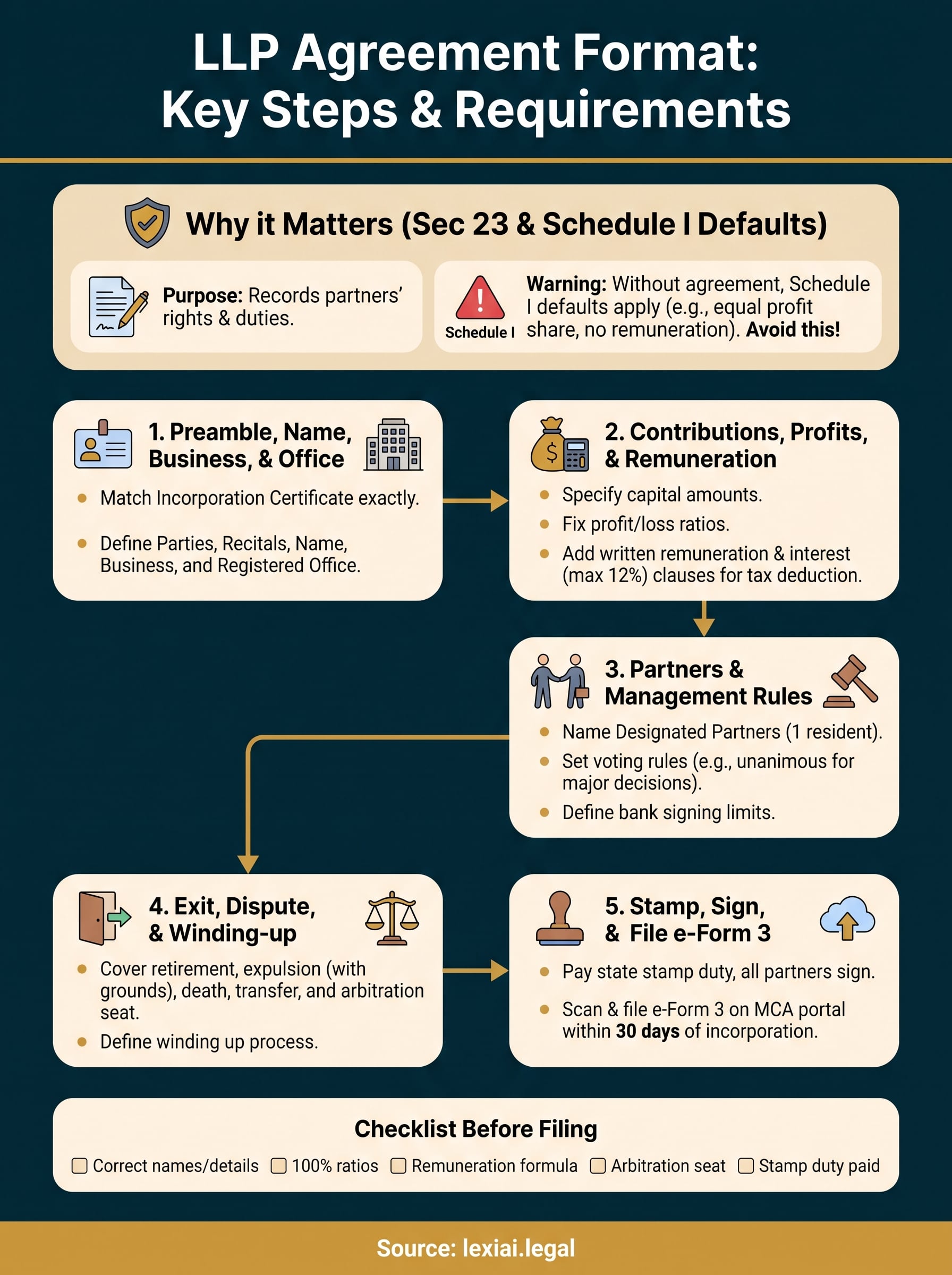
A sound LLP agreement follows one order. Open with the parties, name, business and office, then record contributions and profit sharing, then set partners and management. Add exit and dispute clauses, then stamp, sign and file Form 3 within 30 days of incorporation. Schedule I fills any gap you leave, and its defaults rarely suit the people who signed.
Start with the model clauses above and replace every bracket with a real figure. Then run the checklist against your Certificate of Incorporation before you file. If you want to draft and review the clauses in one place, try a free LeXi AI trial and run your first draft through LeXi Desk before a lawyer signs off.