

5 Best LexisNexis Alternatives for Legal Research in India
If you are searching for a lexisnexis alternative india lawyers actually recommend, the honest answer is that several tools now match or beat LexisNexis on speed, cost, and accuracy for Indian statutes and case law. LexisNexis remains a solid database, but the subscription cost, dated interface, and limited AI drafting support push many lawyers, chambers, and in-house teams to look elsewhere in 2026.
This article answers that search directly. You will find five platforms built for Indian legal research, including AI-powered case law tools that verify sources and summarize judgments in seconds, not the twenty minutes a manual search often takes.
Each entry below covers what the platform does well, where it falls short, and who it suits, whether you are an independent advocate, a corporate legal team handling contracts, or a law student building research skills. We also look at where LeXi AI fits, particularly for lawyers who want research, drafting, and litigation preparation in one connected system rather than five separate logins. By the end, you will know which alternative matches your practice and budget.
1. LeXi AI
LeXi AI leads this list because it does not stop at case law search. It combines litigation preparation, contract lifecycle management, and legal research into one platform built for Indian law, with added coverage for US and UK statutes. Firms that want a single login instead of five subscriptions usually land here first when they start hunting for a lexisnexis alternative india teams can actually adopt firm-wide.
Key features
- LeXi Agent handles legal research, precedent analysis, and drafting acceleration, pulling verified judgments across databases in seconds rather than minutes.
- LeXi LiTT builds case strategy and courtroom-ready drafts at scale, cutting case preparation time by roughly 90 percent according to internal benchmarks.
- LeXi Desk manages the full contract lifecycle, including clause risk flagging (indemnity exposure, for instance), clause generation, and legal translation for filings.
- Case file summarization condenses a 400-page file into a working brief almost instantly.
- On the AIBE 20 legal reasoning benchmark, LeXi AI scored 98.95 percent, ahead of general models like GPT-5.5 and Claude Opus 4.8, on Indian commercial law questions.
A lawyer who needs research, drafting, and contract review in one place outgrows LexisNexis faster than one who only searches judgments.
Best for
Independent lawyers, litigation chambers, and corporate legal teams that want research, drafting, and contract management under one roof, plus enterprises building custom workflows through APIs, fit this platform well. Law students preparing for practice also use LeXi Academy to build research and drafting skills hands-on before they start filing real matters.
Pricing
LeXi AI offers tiered plans for solo practitioners, firms, and enterprises, with API access priced separately for custom builds. Contact the LeXi AI team directly for a quote based on team size, modules needed, and expected query volume.
How it compares to LexisNexis
Where LexisNexis charges for a research database alone, LeXi AI bundles research, drafting, litigation prep, and contract review, which typically replaces two or three separate subscriptions at a comparable or lower total cost. Teams evaluating a lexisnexis alternative india-wide often find the combined workflow cuts more time than a faster search box ever could.
2. SCC Online
SCC Online has been the default legal database for Indian courts and law firms for decades, built around the Supreme Court Cases reporter and a wide judgment archive. Many senior advocates still cite it first because judges and opposing counsel trust its citations without question. It works well as a pure research tool but offers little beyond search, headnotes, and citation tracking.

Key features
- A massive judgment archive spanning Supreme Court, High Courts, and tribunals, with reliable headnotes and citation history.
- Statute annotations and commentary from established legal publishers.
- A citation tool that flags whether a judgment is still good law.
Depth of case law coverage is SCC Online's strength, not speed or drafting help.
Best for
Litigators and researchers who need authoritative citations for court filings, and firms already comfortable paying for a traditional research subscription, suit this platform best.
Pricing
Plans are quoted per user or per firm, typically running higher than newer AI-first tools, with add-on modules priced separately.
How it compares to LexisNexis
SCC Online and LexisNexis overlap heavily in scope and cost, which is why lawyers weighing SCC Online alternatives for legal research often shortlist the same tools. Neither offers integrated drafting or contract tools, so lawyers pair one with a separate AI assistant for that work.
3. Manupatra
Manupatra built its reputation on statute and bare act coverage, especially for company law, tax, and IP practitioners who need the exact text of a provision fast. It has been running since 2000, so its judgment database goes back further than most newer entrants. Many chartered accountants and compliance teams use it alongside lawyers, which is unusual for a legal research tool.
Key features
- A strong bare acts library covering central and state legislation, updated with amendments.
- Sector-specific modules for tax, IP, and corporate law.
- Bilingual access to some regional judgments.
Manupatra suits statute-heavy research better than fast-moving litigation work.
Best for
Corporate counsel, tax practitioners, and IP lawyers who spend more time reading statutory text than arguing appeals will get the most value here.
Pricing
Subscriptions are quoted by module and user count, with tax and IP add-ons priced separately from the core research plan.
How it compares to LexisNexis
Manupatra and LexisNexis compete closely on statute coverage, but neither includes AI drafting or contract review tools, so lawyers comparing Manupatra alternatives or researching a lexisnexis alternative india firms can scale still need a separate platform for that work.
4. Indian Kanoon
Indian Kanoon works differently from every other tool on this list because it is free and open to anyone with a browser. Built as a search engine for Indian case law, it indexes judgments from the Supreme Court, High Courts, and several tribunals without a paywall. Students, journalists, and solo practitioners on tight budgets often start here before they ever consider a paid subscription.
Key features
- Free full-text search across a large judgment archive with no login required.
- Cross-referencing that links citing and cited cases within a judgment.
- Coverage of central acts and some regional High Court decisions others miss.
Free access makes Indian Kanoon the easiest starting point, not the most reliable one for filing-ready citations.
Best for
Law students, junior associates doing preliminary research, and independent practitioners who need a quick case law lookup without paying for a full subscription suit this tool best.
Pricing
Indian Kanoon is free to use, with no premium tier or paid plan.
How it compares to LexisNexis
LexisNexis verifies sources and adds editorial commentary that Indian Kanoon does not, so lawyers treat Indian Kanoon as a free first pass rather than a courtroom-ready citation source.
5. Casemine
Casemine brings a visual, AI-assisted approach to case law research, mapping how judgments cite and influence one another through its TrackIt and Case Crystals tools. It suits lawyers who think in relationships between precedents rather than plain keyword search. Litigators building an appeal often start here to see which judgments carry the most precedential weight.

Key features
- A citation network graph that visualizes how a judgment connects to earlier and later rulings.
- Case Crystals, which extracts the core legal principle from a judgment automatically.
- Coverage across Indian courts plus some US and UK case law for comparative research.
Casemine helps you see how a precedent fits into the bigger picture, which plain text search rarely shows.
Best for
Appellate lawyers and researchers who need to trace precedent history quickly, rather than just find one relevant judgment, benefit most from this platform.
Pricing
Casemine offers a limited free tier, with paid plans quoted for individuals and firms needing full access to its analytics tools.
How it compares to LexisNexis
Unlike LexisNexis, Casemine leans on visualization over editorial commentary, which makes it faster for mapping precedent but thinner on statute annotations.
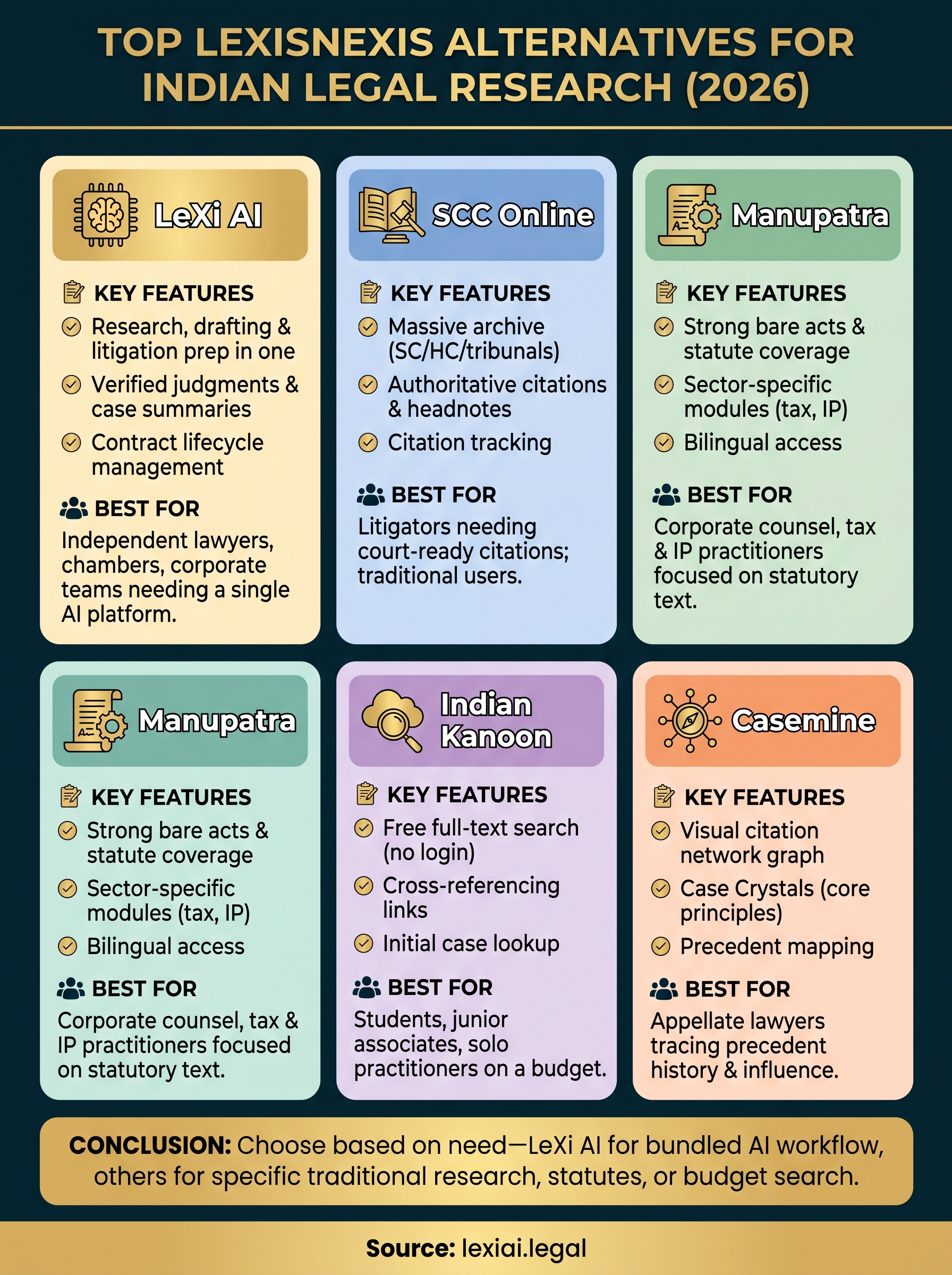
Picking the right research tool for your practice
Your choice comes down to what your practice actually needs, not which name sounds most established, and it helps to see how the wider field of research tools for Indian lawyers stacks up. SCC Online and Manupatra suit lawyers who want deep statutory coverage and are fine paying for a traditional subscription. Indian Kanoon works for students and solo practitioners on a tight budget, while Casemine fits appellate lawyers tracing precedent history through citation maps.
If your work spans research, drafting, and contract review, a single connected platform saves more time than switching between logins ever will. That is the gap LeXi AI fills for firms, chambers, and in-house teams tired of paying for tools that only do one job well. Case law search, litigation prep, and clause risk flagging all sit in one place, built specifically for Indian law.
Before renewing your next LexisNexis invoice, put LeXi AI to the test at no cost and see whether your team still needs five separate subscriptions.