

Execution Petition Format and 4 Steps to File Under CPC
The standard execution petition format is a written application under Order XXI Rule 11(2) of the Code of Civil Procedure, 1908. The decree-holder signs and verifies it, and it states ten particulars in tabular form: suit number, parties, decree date, appeal status, payments received, earlier applications, amount due, costs, the person against whom execution is sought, and the mode of execution. File it in the court that passed the decree, or in a transferee court under Section 39, within 12 years under Article 136 of the Limitation Act, 1963.
Most delays come from small defects, not from the law. A missing column, an unadjusted payment or a vague property description can lead the court to ask for amendment or reject the application under Order XXI Rule 17. The Supreme Court in Rahul S. Shah v. Jinendra Kumar Gandhi (2021) directed that execution proceedings be disposed of within six months of filing, so a clean petition matters.
This guide first explains what you need before drafting. It then gives four steps: choose the court, draft the petition with a copy-ready template, file it with the right documents, and follow it through to recovery. It is general information, not legal advice, and local High Court rules on forms and court fee may differ.
What do you need before drafting an execution petition?
What an execution petition does
An execution petition is the application in which a decree-holder asks the court to enforce a decree against the judgment-debtor. Sections 36 to 74 and Order XXI of the CPC govern it. A decree only declares your right, and recovery of money or possession begins when you file this application.

Section 51 lists the modes of execution: delivery of property, attachment and sale, arrest and detention in civil prison, appointment of a receiver, and any other manner the relief requires. For a money decree, attachment and sale is the usual route.
Decide the mode of execution before you draft, because the rest of the petition depends on it.
Time limit and documents to gather
The time limit is 12 years under Article 136 of the Limitation Act, 1963, counted from the date the decree becomes enforceable. A decree for a mandatory injunction has only three years under Article 135. Older notes that cite three years under Article 182 refer to the repealed 1908 Act.
Do not count on condonation of delay. Section 5 of the Limitation Act excludes applications under Order XXI. Collect these before you start:
- Certified copy of the decree and judgment
- Certified copy of the appellate order, if an appeal was decided
- Statement of payments received since the decree, with dates
- Details of earlier execution applications and their results
- Address, bank details and property survey numbers of the judgment-debtor
- Vakalatnama and court fee as per local rules
Step 1. Choose the court that will execute the decree
Start with the court that passed the decree
Under Sections 37 and 38, the court that passed the decree can execute it. Order XXI Rule 10 contemplates the application being made to that court. If the judgment-debtor lives, works and owns property within its local limits, file there.
Seek transfer when the debtor or property is elsewhere
If the judgment-debtor or the property lies in another district, ask for transfer under Section 39. The court that passed the decree may send it to another court on your application. The grounds include the judgment-debtor residing, carrying on business or working for gain there, too little property in the first district, immovable property outside its limits, or any other reason recorded in writing.
Under Order XXI Rule 6, the transferring court sends a copy of the decree and a certificate stating how much remains unsatisfied. You then file the execution petition before the transferee court.
File where the debtor or the property is, not merely where the decree was passed.
Step 2. Draft the petition in the Rule 11(2) format
The ten particulars Rule 11(2) requires
Rule 11(2) requires the following particulars in tabular form. Missing one invites a defect notice under Rule 17.
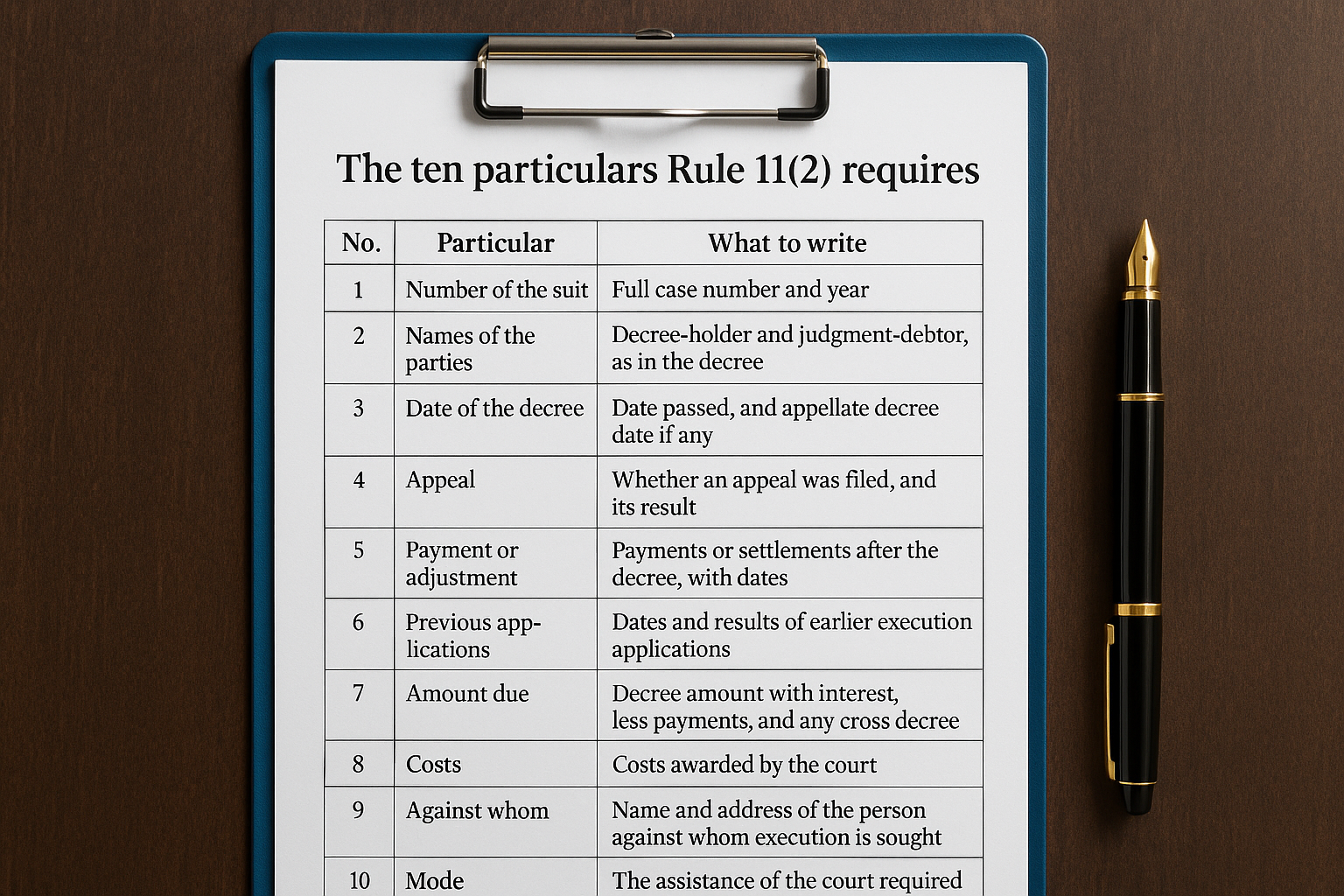
| No. | Particular | What to write |
|---|---|---|
| 1 | Number of the suit | Full case number and year |
| 2 | Names of the parties | Decree-holder and judgment-debtor, as in the decree |
| 3 | Date of the decree | Date passed, and appellate decree date if any |
| 4 | Appeal | Whether an appeal was filed, and its result |
| 5 | Payment or adjustment | Payments or settlements after the decree, with dates |
| 6 | Previous applications | Dates and results of earlier execution applications |
| 7 | Amount due | Decree amount with interest, less payments, and any cross-decree |
| 8 | Costs | Costs awarded by the court |
| 9 | Against whom | Name and address of the person against whom execution is sought |
| 10 | Mode | The assistance of the court required |
Execution petition template to copy and adapt
Replace the text in square brackets and delete what does not apply.
IN THE COURT OF [JUDGE / DESIGNATION], AT [PLACE]

EXECUTION PETITION NO. ____ OF 20__
(Arising out of Suit No. ____ of 20__)

[Name, address]                      ... DECREE-HOLDER
                 VERSUS
[Name, address]                      ... JUDGMENT-DEBTOR

APPLICATION FOR EXECUTION OF DECREE
(Section 51 and Order XXI Rule 11(2), CPC)

The decree-holder submits the following particulars:

1. Number of the suit: [number and year]
2. Names of the parties: [as in the decree]
3. Date of the decree: [date]
4. Appeal against the decree: [filed or not, result]
5. Payment or adjustment after the decree: [details or nil]
6. Previous applications for execution: [dates, results or nil]
7. Amount due with interest: Rs [amount], and cross-decree if any
8. Costs awarded: Rs [amount]
9. Execution sought against: [name and address]
10. Mode of assistance required: [mode, see Schedule]

PRAYER
The decree-holder prays that this Court execute the decree by
[mode] and recover Rs [amount] with interest and costs from
the judgment-debtor.

SCHEDULE OF PROPERTY (if attachment is sought)
[Description sufficient for identification]

                                            DECREE-HOLDER
                                     Through [Advocate]

VERIFICATION
I, [name], verify that paragraphs 1 to 10 are true to my
knowledge and belief. Verified at [place] on [date].
Add the schedule for your mode of execution
The tenth particular points to a schedule or annexure that changes with the mode.
| Mode | What to add | Rule |
|---|---|---|
| Immovable property attachment | Description, boundaries or survey numbers, debtor's share | Order XXI Rule 13 |
| Movable property attachment | Signed inventory with reasonable identification | Order XXI Rule 12 |
| Debts such as bank balances | Account details of the debt to be attached | Order XXI Rule 46 |
| Delivery of immovable property | Description of the property decreed | Order XXI Rule 35 |
| Arrest and detention | Facts showing the debtor has means and refuses to pay | Section 51 proviso |
A vague property description stalls attachment faster than any objection from the debtor.
Step 3. Verify, attach documents and file
Sign, verify and assemble the set
Rule 11(2) requires the petition to be signed and verified by you or by a person proved to know the facts. Add a supporting affidavit if the court expects one, as many do. Then attach the certified decree and judgment, the appellate order if any, the property schedule, and the vakalatnama.
Check the amount in particular 7 against your records. Deduct every payment received after the decree.
File, pay the court fee and clear scrutiny
File through your advocate at the filing counter, or through e-filing where the court permits it. Court fee varies by state, so confirm it with the registry before you file.
The court then checks compliance with Rules 11 to 14 under Rule 17. It may let you cure the defect on the spot or within a fixed time, and it can reject the application if you do not. Ask the registry for the next date and a numbered execution case before you leave.
Filing is complete only when the registry numbers the petition and the court passes its first order.
Step 4. Follow the petition to recovery
What the court does after filing
The court issues process to the judgment-debtor. Notice to show cause under Rule 22 is mandatory where you apply more than two years after the decree, or against a legal representative. For arrest in a money decree, the Section 51 proviso requires a show-cause opportunity and recorded satisfaction that the debtor has means and refuses to pay.
For attached immovable property, the court proceeds to proclamation of sale under Rule 66 and sale under Rule 64. The judgment-debtor or a third party may raise objections, such as claims under Rule 58. Questions between the parties to the decree are decided by the executing court under Section 47, not in a separate suit.
Attend every date, because the six-month disposal direction depends on both sides moving the case forward.
Where AI tools help with the work
Use a tool to check the draft against the ten Rule 11(2) particulars and to find precedents on limitation and objections. LeXi LiTT supports AI-assisted drafting, and LeXi Agent supports research and precedent analysis across Supreme Court and High Court judgments.
Treat the output as a first draft. Verify every rule and citation, and have an advocate review the petition before filing.
Final checks before you file
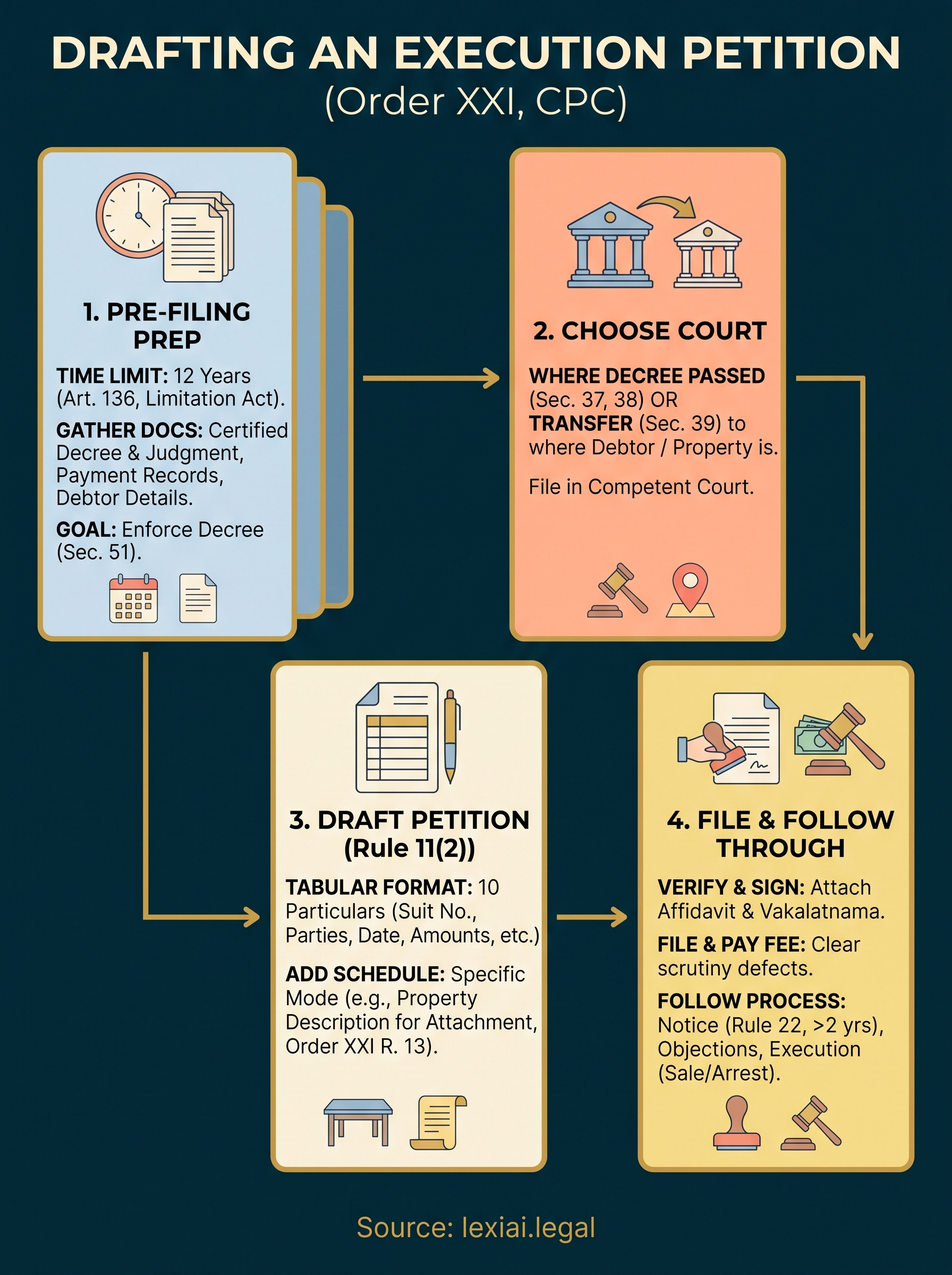
An execution petition succeeds when it is filed in the right court within time, states all ten Rule 11(2) particulars, and names a clear mode of execution with a precise schedule. Check the amount due, attach the certified decree, and keep the verification signed.
If you want help drafting and checking the petition, you can test LeXi AI free on your next execution matter.