

10 Best AI Agents for Lawyers in India (2026)
Most Indian law firms still lose hours every week to repetitive drafting, case file review, and precedent searches that a machine could handle in minutes. If you are trying to figure out which ai agents for lawyers actually work for Indian statutes and case law, rather than generic AI built for US contracts, you are asking the right question at the right time. Contract review, litigation prep, and legal research have all moved past simple chatbots into agents that can draft, flag risk, and pull verified judgments on command.
This article gives you a direct answer: ten AI agents built or adapted for Indian legal practice, what each one actually does, and where it fits into your workflow. We cover specialized litigation tools and general research agents, comparing accuracy on Indian commercial law, not just marketing claims.
You will see tools built for contract lifecycle management, courtroom preparation, and case file summarization, including where LeXi AI fits for Indian-specific benchmarking and unified workflows. By the end, you should know which agent matches your practice, whether you run a solo chamber or manage a corporate legal team.
1. LeXi AI
LeXi AI sits at the top of this list because it is built specifically for Indian law, not retrofitted from a US contract tool. The LeXi AI platform combines four modules, LeXi LiTT for litigation prep, LeXi Desk for contract lifecycle work, LeXi Agent for research, and LeXi Academy for students, into one connected system rather than four separate logins. On the AIBE 20 exam scored against GPT, Gemini and Claude, LeXi AI claims a 98.95% accuracy score against general models like GPT 5.5 and Claude Opus 4.8, specifically on Indian commercial law questions.

How it works
Unlike a general chatbot, LeXi AI pulls from verified Indian judgment databases and statutory sources before generating an answer, so citations trace back to actual case law rather than a hallucinated reference. You feed it a case file, a draft contract, or a research query, and the relevant module (LiTT, Desk, or Agent) processes it against Indian precedent and drafting conventions. Enterprise clients can also plug LeXi AI's APIs directly into their own case management software.
An AI agent for lawyers is only as good as the law it was trained on, and LeXi AI trains on Indian statutes and judgments first.
Key features
- Case file summarization: condenses a 400-page file into a working brief in minutes
- Clause risk flagging: catches indemnity and liability risks during contract review
- Instant judgment search: verified sources across major Indian judgment databases
- Legal translation: handles filings and documents across regional languages
- Enterprise APIs: for firms building custom AI-powered legal systems
Best for
Solo advocates juggling litigation and drafting will find LiTT and Desk useful on their own, but the platform is built for firms and corporate legal teams that want one system covering research, contracts, and courtroom prep instead of three disconnected subscriptions. Corporate legal departments running high contract volumes benefit most from Desk's clause generation and risk analysis, while litigators lean on LiTT for case strategy and courtroom-ready drafts. Law students get a separate track through LeXi Academy, which mirrors real research and drafting tasks rather than abstract quizzes.
Pricing
Pricing scales by module and firm size, with separate plans for independent lawyers, chambers, corporate legal teams, and enterprises needing API access. Academy access for law students is priced separately from the professional tiers. You can check current plans and request a demo directly on the LeXi AI pricing page since rates are subject to change as new features roll out.
2. CaseMine CaseIQ
CaseMine CaseIQ is a research-focused AI agent built around India's largest case law database, and it markets itself as a citation and precedent discovery tool rather than a full practice platform. Firms already using CaseMine for judgment search often add CaseIQ as the natural next step, since it works inside the same database they already trust.
How it works
CaseIQ reads a query or an uploaded brief and returns a ranked list of relevant judgments, complete with citation networks showing how each case has been cited or overruled since. It also flags conflicting precedents automatically, which matters when you are building an argument on shaky ground and do not know it yet.
A research tool that cannot show you when a precedent has been overruled is not doing research, it is just searching.
Key features
- Citation network mapping across Indian judgments
- Precedent conflict detection to flag overruled or distinguished cases
- Semantic search that understands legal phrasing, not just keyword matches
- Brief analysis that pulls relevant case law from an uploaded document
Best for
Litigators and research-heavy chambers that need deep case law discovery will get the most value here, particularly firms handling appellate work where precedent history carries real weight, though it is worth weighing CaseIQ against other AI tools for case law discovery in India. Solo practitioners doing occasional research may find the depth more than they need for routine matters.
Pricing
CaseIQ is typically bundled into CaseMine's subscription tiers rather than sold standalone, with enterprise pricing for firms and separate rates for individual practitioners. Exact figures require a quote from CaseMine directly, since the platform does not publish flat rates for its AI research layer.
3. SpotDraft
SpotDraft is a platform for managing contracts from drafting to renewal built for corporate legal teams that handle high contract volumes, and it has picked up traction among Indian startups and mid-size companies managing vendor and employment agreements. Unlike LeXi Desk, which is built around Indian statutory language from the ground up, SpotDraft originated as a US-focused tool and has since added support for Indian contract templates and clause libraries.
How it works
Users upload a contract or start from a template, and SpotDraft's AI reviews the document against a pre-set playbook of approved clauses, flagging deviations before the contract goes out for signature. Teams can also route contracts through custom approval workflows, so legal, finance, and business stakeholders sign off in sequence rather than over scattered email threads.
A contract playbook only works if the AI actually checks every clause against it, not just the ones a lawyer remembers to flag.
Key features
- Clause playbook enforcement across incoming and outgoing contracts
- Automated approval workflows with role-based routing
- Repository search for retrieving old contracts and clause history
- E-signature integration built into the closing process
Best for
Corporate legal teams running high contract volumes, particularly in SaaS and services businesses, get the most out of SpotDraft's playbook automation. Firms whose primary work is litigation or courtroom drafting will find little use here, since SpotDraft does not touch case research or courtroom preparation.
Pricing
SpotDraft sells through custom enterprise quotes rather than published tiers, with pricing typically scaled to contract volume and number of seats. Smaller firms report that costs run higher than India-first alternatives once you add advanced workflow features, so it is worth checking what CLM platforms typically charge and comparing total contract volume against the quote before committing.
4. Harvey AI
Harvey AI is the legal AI tool that most big global firms talk about first, built on top of large language models and backed by OpenAI's own investment arm, and it appears on most lists of the legal technology vendors worth knowing. It launched for US and UK law firms handling due diligence and complex litigation, and Indian firms with international clients have started testing it for cross-border matters where US or English law applies. For pure Indian statutory work, though, Harvey was never trained with Indian case law as a priority.

How it works
Lawyers upload documents, contracts, or case files, and Harvey generates drafts, summaries, and research memos using a general-purpose model fine-tuned on legal writing conventions. It can also connect to a firm's document management system, so associates query it the way they would ask a senior partner for a quick answer.
A legal AI agent trained mostly on US and UK law will guess at Indian statutory nuance, not know it.
Key features
- Document Q&A across uploaded contracts and case files
- Due diligence workflows for transactional teams
- Drafting assistance for memos, letters, and contract clauses
- Integration options with existing firm document systems
Best for
Large firms with cross-border transactional work, especially where a matter touches US or English law alongside Indian statutes, get the clearest use case here. Litigators focused purely on Indian courts and Indian precedent will find the coverage thin compared to India-built tools.
Pricing
Harvey sells through enterprise contracts negotiated directly with firms, and pricing is not published publicly. Reports from firms that have adopted it suggest costs sit well above India-first platforms, reflecting its positioning toward large international firms rather than solo practitioners or mid-size Indian chambers.
5. Manupatra AI research assistant
Manupatra has been a staple legal database for Indian lawyers since long before AI agents existed, and its research assistant layer adds natural language search on top of that existing archive. Firms that already subscribe to Manupatra for statutes, judgments, and commentary often treat the AI research assistant as a free upgrade rather than a separate purchase, since it sits inside the same login they already use daily.
How it works
Queries go through Manupatra's AI layer in plain language, and the assistant returns relevant statutes, judgments, and secondary commentary drawn from its own database rather than the open internet. It also summarizes long judgments into shorter briefs, though the summaries stay closer to the source text than a fully generative tool would produce.
Database depth built over decades still counts for something that a newer AI agent cannot replicate overnight.
Key features
- Natural language search across statutes, judgments, and commentary
- Judgment summarization for lengthy case law
- Cross-referencing between related statutory provisions
- Bare Act integration with annotated case law
Best for
Lawyers who already rely on Manupatra as their primary research database get the most value here, since the AI layer works within a tool they know rather than asking them to learn something new. Firms without an existing Manupatra subscription may find dedicated research agents built around generative drafting a better fit for daily research tasks, and there are several cheaper research platforms that replace Manupatra worth reviewing.
Pricing
Access comes bundled into existing Manupatra subscription tiers, with the AI research assistant included at no separate charge for most subscribers. Standalone AI-only pricing is not published, since Manupatra positions the feature as an enhancement to its core database product rather than a separate offering.
6. Leya AI
Leya AI is a European legal AI agent built for large firms handling cross-border transactional work, and it has gained attention among firms in the UK and continental Europe for its document review and workflow automation. Some Indian firms with international arbitration practices have started piloting it, mostly for matters where the governing law sits outside India. As an ai agents for lawyers option built for European legal frameworks, it brings strong workflow tooling but limited grounding in Indian statutory language.
How it works
Leya connects to a firm's existing document repository and lets lawyers query contracts, case files, and precedent through a conversational interface, similar to asking a colleague to pull the relevant clause. The agent can also chain tasks together, so a single request might trigger a document search, a summary, and a draft revision in sequence rather than three separate steps.
An agent that chains research, summary, and drafting into one request saves the back-and-forth that eats up a junior associate's day.
Key features
- Multi-step task chaining across research, summary, and drafting
- Document repository integration with existing firm systems
- Workflow automation for repetitive transactional tasks
- Custom agent building for firm-specific processes
Best for
Large firms running cross-border transactional practices, particularly those with European or UK-governed matters, get the most direct benefit from Leya's workflow chaining. Firms whose work is primarily Indian litigation or statutory research will find the platform less relevant, since it was not built around Indian precedent or drafting conventions.
Pricing
Leya sells through direct enterprise contracts rather than published tiers, with pricing scaled to firm size and the number of custom workflows deployed. Firms evaluating it should expect a sales conversation and a quote rather than a self-serve signup, and costs generally sit closer to Harvey's enterprise range than to India-first tools.
7. Kira Systems
Kira Systems is one of the older names in contract review AI, built for due diligence teams that need to extract specific clauses across hundreds of contracts at once. Law firms doing mergers and acquisitions work often mention Kira first when discussing contract analysis software, since it predates most of the newer generative AI wave and has years of extraction accuracy behind it. Indian firms handling cross-border M&A sometimes license it alongside local research tools rather than as a replacement for them.
How it works
Kira scans uploaded contracts against a library of pre-built and custom clause models, pulling out specific provisions like change of control, indemnification caps, or termination rights across an entire document set. Reviewers get a spreadsheet-style output showing exactly where each clause sits, which speeds up due diligence checklists that would otherwise take a junior associate days to compile manually.
Extraction accuracy across thousands of contracts matters more in due diligence than clever drafting suggestions ever will.
Key features
- Clause extraction across large contract sets using pre-built and custom models
- Due diligence checklists generated automatically from extracted data
- Machine learning training on firm-specific clause libraries
- Integration with document review platforms used in deal rooms
Best for
Transactional teams running large-scale due diligence, particularly in M&A and real estate portfolios, get the clearest return from Kira's extraction speed. Litigators and solo practitioners handling Indian statutory matters will find little application here, since the tool is built entirely around bulk contract review rather than case law or courtroom drafting.
Pricing
Kira sells through enterprise licensing negotiated per firm, with costs tied to contract volume and the number of custom clause models deployed. Published pricing does not exist, and most Indian firms report needing a direct sales conversation before getting a workable quote.
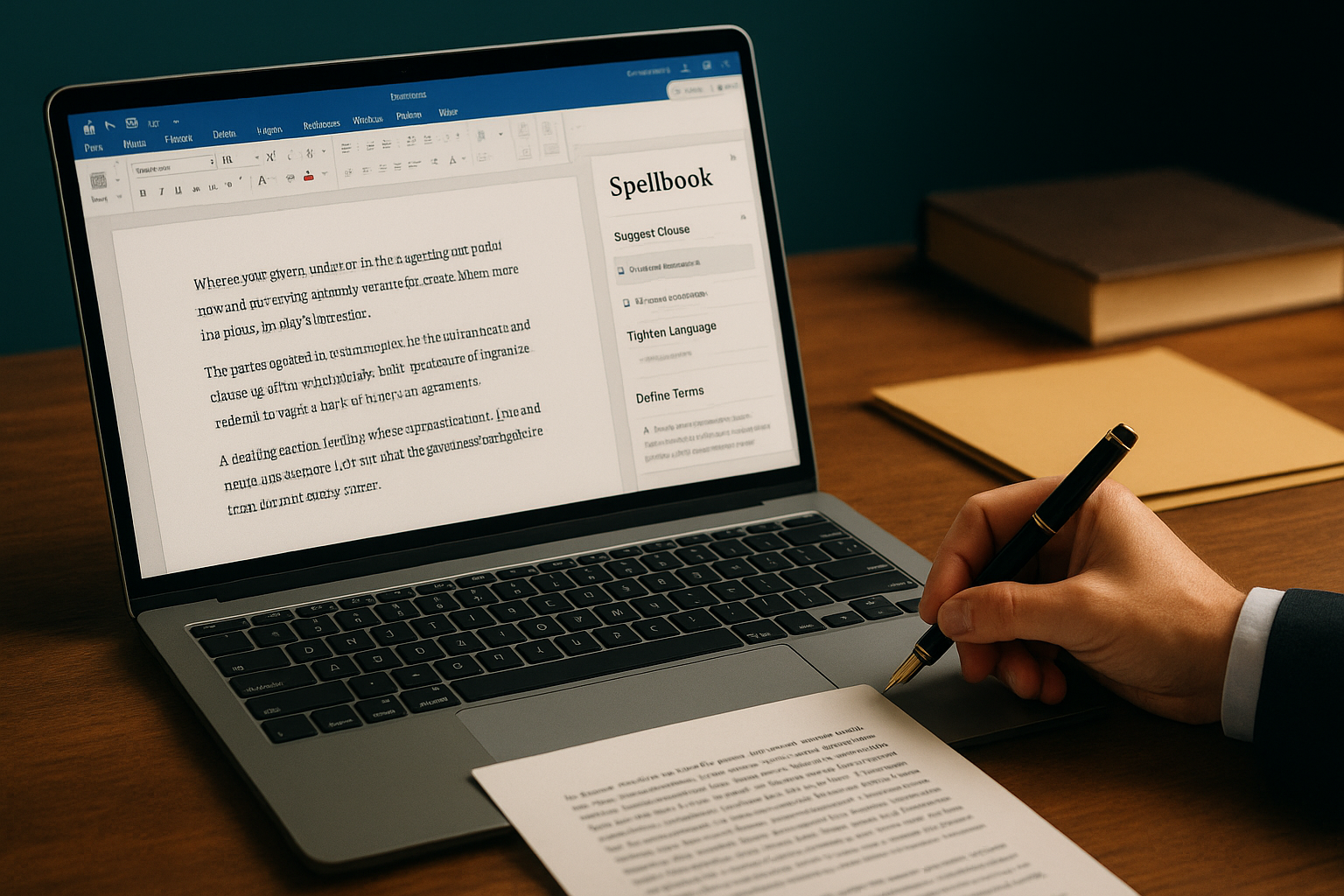
8. Spellbook
Spellbook is one of many drafting tools that assist lawyers with documents, living inside Microsoft Word rather than a separate browser tab, and it markets itself squarely to transactional lawyers who draft contracts all day. Among ai agents for lawyers built for Word-native workflows, it is the one most firms mention first, since adoption requires no new interface to learn. Indian firms with US or UK clients have picked it up for cross-border contract drafting, though its clause library leans heavily on American and English contract conventions.
How it works
Spellbook runs as a Word add-in, reading the open document and suggesting clause language, redlines, and definitions as you type. You can ask it to draft a new clause, tighten existing language, or flag terms that deviate from market standard, and it responds inside the same document rather than a separate export.
A drafting tool built into the word processor saves the copy-paste cycle that eats up half a redline session.
Key features
- In-document drafting directly inside Microsoft Word
- Clause suggestion based on market-standard language
- Redline review that flags unusual or risky terms
- Definition checking across long-form agreements
Best for
Transactional lawyers who spend most of their day drafting inside Word, particularly at firms with US or UK-facing contract work, get the clearest benefit. Litigators and firms drafting primarily under Indian statutory templates will find less value, since Spellbook's clause library was not built around Indian contract conventions.
Pricing
Spellbook sells through monthly per-seat subscriptions aimed at individual lawyers and small firms, alongside enterprise tiers for larger teams. Rates are published on Spellbook's own site and tend to sit lower than Harvey or Leya, though firms should confirm current pricing directly since AI subscription tiers shift often.
9. CoCounsel by Thomson Reuters
CoCounsel is Thomson Reuters' AI agent built on top of Westlaw's research infrastructure, and it targets the same due diligence and research tasks Harvey covers, but with a legal publisher's database behind it rather than a general model. Firms already paying for Westlaw or Practical Law often add CoCounsel as a natural extension, since it reads from content they already trust. Indian firms with US-facing practices have picked it up for cross-border research, though its case law coverage stays weighted toward American and English jurisdictions.
How it works
CoCounsel accepts a research question, a contract for review, or a deposition transcript, and it runs the task against Thomson Reuters' proprietary content alongside generative drafting. Skill-based workflows let a lawyer select a specific task, such as extracting contract provisions or summarizing a deposition, rather than typing a free-form prompt and hoping for a usable answer.
An agent built on a publisher's own database inherits that database's jurisdictional bias, for better or worse.
Key features
- Document review with clause extraction across contracts
- Deposition summarization for litigation preparation
- Legal research drawing on Westlaw and Practical Law content
- Drafting assistance for memos and correspondence
Best for
Firms already subscribed to Westlaw or Practical Law, particularly those with US-facing litigation and research needs, get the clearest value from CoCounsel's integration. Indian litigators working purely under Indian statutes will find the research layer thin compared to India-built research agents.
Pricing
CoCounsel sells through Thomson Reuters enterprise contracts, with pricing tied to existing Westlaw subscriptions and seat count. Published rates do not exist, and firms typically negotiate through an existing account representative rather than a self-serve signup.
10. Clio Duo
Clio Duo is the AI layer built into Clio's practice management software, and it targets the administrative side of legal work rather than research or drafting. Firms already running their case management and billing software through Clio get Duo as an add-on inside the same dashboard, so there is no new login or migration involved. Among the ai agents for lawyers on this list, Duo is the only one built primarily around practice operations instead of legal substance.
How it works
Duo reads across a firm's existing Clio data, matters, time entries, documents, and communications, and surfaces answers or drafts based on that context. Ask it to summarize a matter's recent activity or draft a client update, and it pulls directly from records already sitting in the system rather than requiring a fresh upload.
An AI agent tied to your practice management software knows your matters already, it does not need to be told.
Key features
- Matter summarization pulled from existing case records
- Time entry assistance for capturing billable work more accurately
- Client communication drafts based on matter history
- Document search across files already stored in Clio
Best for
Small firms and solo practitioners already running their practice through Clio get the most direct benefit, since Duo adds AI on top of a system they use daily anyway. Firms doing heavy litigation research or complex contract review will still need a dedicated tool alongside Duo, since it does not touch case law or clause analysis.
Pricing
Clio Duo comes bundled into higher Clio subscription tiers rather than sold as a separate product, with per-user monthly pricing scaling by plan level. Firms should check Clio's own pricing page directly, since tiers and included features change periodically.
11. How to choose the right AI agent for your practice
Picking from the list above starts with an honest look at what actually eats your time each week. A litigator drowning in case file review needs LiTT or CaseIQ, not a Word plugin built for redlining vendor contracts. A corporate legal team pushing fifty contracts a month cares more about playbook enforcement than judgment search depth. Match the tool to the task before you match it to the marketing page, and a feature-by-feature look at legal AI platforms for Indian firms helps narrow the shortlist.
Budget matters just as much as function. Enterprise contracts from Harvey, Leya, or Kira make sense for large firms with dedicated procurement teams, but a solo advocate or small chamber usually gets better returns from platforms with transparent per-seat pricing.
The right ai agents for lawyers are the ones built around the law you actually practice, not the ones with the biggest name in legal tech news.
Run through this checklist before you commit to a subscription:
- Jurisdiction fit: does the agent train primarily on Indian statutes and judgments, or is Indian coverage bolted onto a US or UK model?
- Workflow overlap: does it replace a tool you already pay for, or add a fourth login to manage?
- Team size: does pricing scale sensibly for your headcount, or does it assume enterprise budgets?
- Output verification: can you trace every citation back to a real source, or does the tool hallucinate under pressure?
- Trial access: can you test it on a real file before signing a year-long contract?
Running two or three shortlisted tools against the same case file for a week tells you more than any comparison chart, including this one. Watch how each agent handles ambiguity in an Indian statute, not just how fast it drafts a clean paragraph.
12. Data security checks before you adopt a legal AI agent
Before you upload a single privileged document to any AI platform, ask where that data actually goes. Most ai agents for lawyers run on third-party cloud infrastructure, and once a case file or draft contract leaves your system, you need to know whether it gets stored, used to train future models, or shared with subprocessors you have never heard of, which is why protecting client data inside AI tools deserves its own review. Attorney-client privilege does not survive carelessly worded terms of service.
Demand a straight answer on data retention policies before you sign anything. Some vendors delete uploaded files after processing, others retain them indefinitely for model improvement unless you explicitly opt out. Read the clause, not the sales pitch, and get it confirmed in writing if the platform's public terms stay vague.
A legal AI agent that will not say where your client's data lives is not ready for your case files.
Server location matters more for Indian firms than most vendors admit upfront. Check whether the platform stores data on servers within India or routes everything through US or European data centers, since that affects both compliance obligations and how quickly you can respond if a client asks where their documents sat.
Run through this list with any vendor before onboarding:
- Encryption standard: is data encrypted both in transit and at rest, or only one of the two?
- Training data usage: does the vendor use your uploads to train its general model, or keep client data isolated?
- Access controls: can you restrict which staff members see which matters inside the platform?
- Breach notification: what is the vendor's contractual timeline for informing you of a data breach?
- Deletion rights: can you request permanent deletion of a matter's data on termination of the contract?
Treat these questions as non-negotiable, not as a formality you skip because a demo looked impressive.
13. Benefits and limitations of AI agents in Indian legal practice
Speed is the most obvious gain. Case file review that once took a junior associate three days now takes an afternoon, and research that meant hours in a library now returns cited judgments in seconds. Firms adopting ai agents for lawyers report fewer billable hours lost to repetitive drafting, which frees senior lawyers for strategy rather than paperwork.

Cost savings follow naturally from that speed, but only if you pick a tool matched to your actual caseload. Overbuying an enterprise contract for a two-partner chamber wastes money faster than the manual work it replaces.
An AI agent saves time only when it is doing work you would otherwise pay a person to do slowly.
Limitations show up just as fast once you push past routine tasks. Hallucinated citations still happen, especially with general models never trained on Indian statutes, and courts have already sanctioned lawyers elsewhere for filing AI-generated fiction as case law, so it pays to know how accurate legal AI actually is on benchmarks. Novel legal questions, ones without settled precedent, still need a human lawyer's judgment, not a probability score.
Relying too heavily on any single tool also creates a dependency risk if the vendor changes pricing or shuts down a feature overnight.
| Benefit | Limitation |
|---|---|
| Faster document and case file review | Cannot handle genuinely novel legal arguments |
| Lower research costs over time | Risk of citation hallucination without verification |
| Consistent clause and risk flagging | Jurisdiction gaps in tools built outside India |
| Frees senior time for strategy | Vendor dependency if pricing or access changes |
Treat every output as a draft from a very fast junior, not a finished opinion. Verification stays your job, and no AI agent changes that.
14. Frequently asked questions about AI agents for lawyers
What are AI agents for lawyers?
An AI agent for lawyers is software that goes beyond a chatbot and actually performs a task, drafting a clause, summarizing a case file, or pulling verified judgments, based on a specific instruction. Unlike a search engine, it chains steps together on its own once you give it the starting prompt. Legal AI assistants for Indian lawyers train on Indian statutes and case law, while many international tools default to US or UK legal frameworks.
Can AI agents replace lawyers in India?
No. Courts still require a human lawyer to verify citations, apply judgment to novel facts, and sign off on filings. AI agents for lawyers speed up drafting and research, but the Bar Council has not recognized any AI tool as a substitute for a licensed advocate. Treat every output as a first draft, not a final opinion.
An AI agent drafts faster than any associate, but it cannot yet take responsibility for what it drafts.
Are AI agents for lawyers safe to use with confidential client data?
Only if the vendor confirms encryption, data retention limits, and server location in writing. Some platforms isolate client uploads from model training, others do not, so check the terms before uploading a single privileged file. Data security policies vary widely across the tools covered in this list, and India-built platforms often store data closer to home.
How much do AI agents for lawyers cost in India?
Pricing ranges from per-seat monthly subscriptions under a few thousand rupees to enterprise contracts running into lakhs annually. Solo advocates and small chambers generally do better with transparent, published tiers rather than negotiated enterprise deals built for large firms.
What this means for your practice
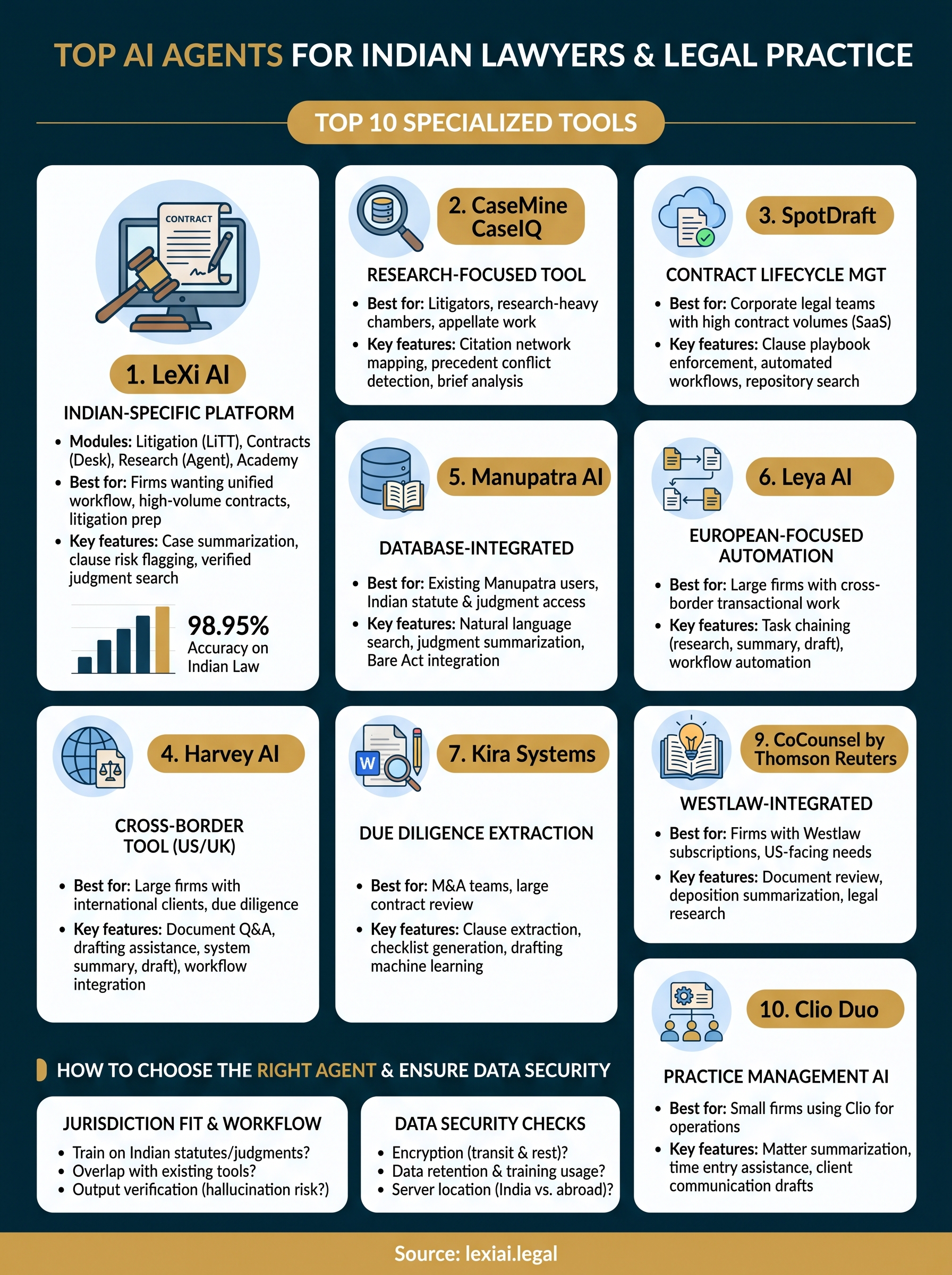
The ten tools above cover different corners of legal work, but the pattern is clear. Jurisdiction fit decides whether an AI agent saves you time or creates new risk, and general models built for US or UK law will always guess at Indian statutory nuance. Speed matters, but only when paired with verifiable citations and clause logic trained on the law you actually practice.
Start with an honest audit of where your week actually goes, research, drafting, or contract review, then test one tool against a real file before committing to a subscription. Tools built specifically for Indian statutes and case law will consistently outperform retrofitted ones on the matters that land on your desk.
If you want a platform that unifies litigation prep, contract lifecycle work, and research instead of juggling three logins, run LeXi AI against your next case file at no cost before you decide.