

Relinquishment Deed Format: Sample Clauses and Registration
A relinquishment deed format is the written structure of a document in which a co-owner or legal heir (the releasor) gives up their share in inherited or jointly owned property in favor of another co-owner (the releasee). The standard format has a title, date and place, party details, recitals explaining how the share arose, a property schedule, the release clause, a voluntary-act declaration, and two witnesses. It is executed on stamp paper as your state requires and registered under the Registration Act, 1908.
The deed matters because a verbal family settlement or a signed "no objection" letter does not move title in immovable property. Only a registered instrument does. A weak draft, wrong stamp paper, or missed registration deadline can leave the releasee with a document that a court or sub-registrar will not accept.
This article explains why the deed matters, gives you a format you can copy and adapt, and sets out the stamp paper and registration steps. It also covers the risks that arise after signing, including cancellation and tax. Where drafting is involved, tools such as LeXi Desk can help you check clauses, but the legal choices below stay with you and your advocate.
Why does a relinquishment deed matter?
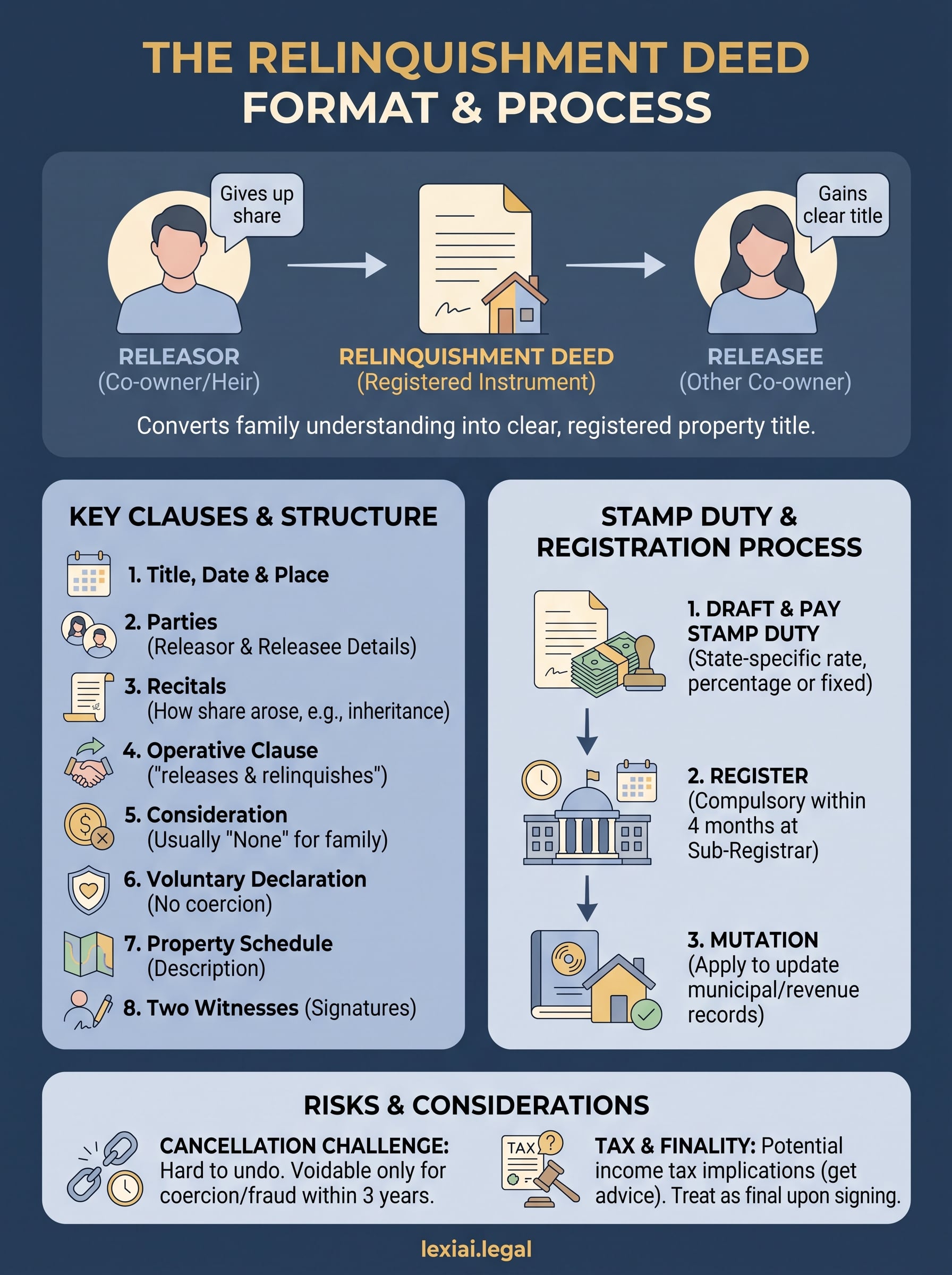
A relinquishment deed matters because it converts a family understanding into clear, registered title. Without it, the releasor's name stays in the records and their legal heirs can still claim the share years later.
What problem does a relinquishment deed solve?
Take a common case. A father dies intestate, and the flat passes to a son and a daughter under the Hindu Succession Act, 1956. The daughter does not want a share and tells the family so. Unless she signs a registered deed, she remains a co-owner with an undivided half, and so do her heirs after her.

The rule is strict. Section 17(1)(b) of the Registration Act, 1908 requires registration of a non-testamentary document that extinguishes a right in immovable property worth Rs. 100 or more. Since Vineeta Sharma v. Rakesh Sharma (2020), daughters are coparceners by birth, so a written and registered release is now routine in Hindu joint family property.
A signed letter or a verbal promise does not remove a name from the title. A registered deed does.
How is it different from a gift deed or a sale deed?
All three move rights in property, but they suit different situations. A release works when the receiving person already holds a share. If the receiver is a stranger to the property, use a gift deed or sale instead.
| Point | Relinquishment deed | Gift deed | Sale deed |
|---|---|---|---|
| Who receives | An existing co-owner or co-heir | Any person | Any buyer |
| Consideration | Usually none | None | Price paid |
| Main provisions | Registration Act s. 17(1)(b), Stamp Act "Release" article | Transfer of Property Act ss. 122 and 123 | Transfer of Property Act s. 54 |
| Stamp duty | State rate for releases | State rate for gifts | State conveyance rate |
How do you draft a relinquishment deed?
You draft it by stating who releases what, to whom, why the releasor holds the share, and that the act is voluntary. Keep each clause short and each fact verifiable from the title documents.
Which clauses should a relinquishment deed contain?
Use this order. Each clause has one job, and a sub-registrar expects to find all of them.
- Title and date: "Deed of Relinquishment" with place and date.
- Parties: full names, parentage, age, address and ID numbers of the releasor and releasee.
- Recitals: how the property came to the parties, such as the death of the owner and the list of legal heirs.
- Operative clause: the words of release, such as "releases and relinquishes absolutely and forever".
- Consideration: state whether any money passes.
- Voluntary declaration: no coercion, fraud or undue influence.
- Schedule: survey or door number, area, boundaries, and registered title reference.
- Witnesses: two witnesses with names, addresses and signatures.
What does a ready-to-use relinquishment deed look like?
Copy the text below and replace the brackets. Delete the alternative consideration line that does not apply.
DEED OF RELINQUISHMENT

This Deed of Relinquishment is made at [place] on this ___ day of [month], [year],

BY: [Name], son/daughter/wife of [name], aged about __ years, residing at [address], holding PAN/Aadhaar No. [number] (the "Releasor").

IN FAVOR OF: [Name], son/daughter/wife of [name], aged about __ years, residing at [address], holding PAN/Aadhaar No. [number] (the "Releasee").

WHEREAS [name of deceased] died intestate on [date] at [place], leaving behind the legal heirs named in Schedule A.
WHEREAS the property described in Schedule B devolved on the legal heirs, and the Releasor holds an undivided [fraction] share in it.
WHEREAS the Releasee is a co-owner of the said property, and the Releasor, out of natural love and affection, wishes to release the whole of that share in favor of the Releasee.

NOW THIS DEED WITNESSETH AS FOLLOWS:

1. The Releasor hereby releases and relinquishes absolutely and forever all right, title, interest, claim and share in the Schedule B property in favor of the Releasee.
2. This release is made without any monetary consideration. [Alternative: This release is made for a consideration of Rs. ______ received by the Releasor from the Releasee.]
3. The Releasor declares that this deed is executed voluntarily, without coercion, undue influence, fraud or misrepresentation, and with full knowledge of its effect.
4. The Releasor declares that the share has not been sold, gifted, mortgaged or otherwise encumbered, and that no litigation is pending in respect of it.
5. The Releasor and the Releasor's heirs and successors shall have no claim in the property after this deed.
6. The Releasee may mutate the property records in the Releasee's name, and the Releasor shall sign any further document reasonably required for that purpose.
7. Stamp duty and registration charges shall be borne by the Releasee.

SCHEDULE A: Names, ages and relationships of the legal heirs.
SCHEDULE B: [Full description of the property with address, survey number, area and boundaries.]

IN WITNESS WHEREOF the parties have signed this deed on the date first written above.

Releasor: ____________    Releasee: ____________

Witness 1: [name, address, signature]
Witness 2: [name, address, signature]
How do you adapt the format to your case?
Change the recitals first, because they describe how the share arose. Inheritance under a will, a partition, or joint purchase each needs different wording, and personal law decides who the co-owners are.
Some situations need extra care. If several heirs release, list each as a releasor and add a separate voluntary declaration for each. If a minor holds a share, the guardian cannot release it without court permission under Section 8 of the Hindu Minority and Guardianship Act, 1956. If money changes hands, keep clause 2 accurate, since the stamp duty may then be computed differently. In LeXi Desk, you can run the finished draft through clause risk analysis before it goes to an advocate.
Draft the recitals from your title documents, not from memory, because the recitals are the part most often challenged.
What stamp paper and registration does the deed need?
The deed must be on stamp paper of the value your state requires and registered at the sub-registrar office where the property lies. Stamp duty and registration fees are state subjects, so no single national figure applies.
How much stamp duty and which stamp paper?
Duty is set by the Indian Stamp Act, 1899 as amended by each state, under the "Release" article of its schedule. Some states charge a percentage of the market value of the released share, some charge a fixed amount, and some give concessions for releases among close family. Check your state's current schedule or ask the sub-registrar before buying paper.
Here is an illustration. A flat is worth Rs. 80 lakh and two siblings inherit it equally, so the sister releases a share worth Rs. 40 lakh. At an assumed rate of 2% on the released share, which is not any state's actual rate, duty would be Rs. 80,000. Substitute your state's rate in the same way. Many states also allow e-stamping or franking, so a physical stamp paper may not be needed.
Stamp duty on a release depends on your state's schedule, so confirm the rate before you print the deed.
How do you register a relinquishment deed?
Registration is compulsory under Section 17(1)(b) of the Registration Act, and an unregistered deed cannot affect the property under Section 49. Follow these steps.

- Draft the deed and pay stamp duty.
- Gather documents: ID and PAN of both parties, passport photographs, title papers, the death certificate, a legal heir certificate or family tree, and recent property tax receipts.
- Book a slot with the sub-registrar of the area where the property is located (Section 28).
- Present the deed within four months of execution (Section 23). A short delay can be condoned on a fine under Section 25.
- All parties and the two witnesses appear before the sub-registrar for identification and examination (Sections 34 and 35).
- Pay the registration fee and collect the registered deed after endorsement.
- Apply for mutation of the municipal or revenue records.
What can go wrong with a relinquishment deed?
The main risks are a challenge to the deed after signing and unexpected tax consequences. Both can be reduced by careful drafting and advice before execution.
Can a registered relinquishment deed be cancelled?
A registered deed is not easily undone, but it can be set aside if the releasor was coerced or deceived. Sections 15, 17 and 19 of the Indian Contract Act, 1872 treat coercion and fraud as grounds to make an agreement voidable. Section 31 of the Specific Relief Act, 1963 allows a suit to cancel such an instrument.
The limitation period is three years under Article 59 of the Limitation Act, 1963, counted from when the facts first become known to the plaintiff. The voluntary declaration, independent witnesses, and a clear record that the releasor understood the document all help the releasee defend it.
Does a relinquishment deed attract tax?
It can. Income tax law defines a transfer to include relinquishment of an asset, and a release for money is more likely to be treated as a taxable transfer. A release without consideration among legal heirs is treated differently, and the outcome depends on facts. Ask a chartered accountant before signing.
Stamp duty is a separate cost. Also note that a release is irrevocable in practice, so a releasor who changes their mind later must prove fraud or coercion in court.
Treat the deed as final the day you sign it, and take tax advice before that day.
Where to go from here
A relinquishment deed gives up a share in property you already co-own, and it works only when it is drafted precisely, stamped at your state rate, and registered within four months. Use the format above, fit the recitals to how the share arose, and keep both witnesses and the voluntary declaration in place.
Before you sign, have an advocate review the draft against your title papers and your state's stamp schedule. If you draft deeds regularly, you can run a free LeXi AI trial, which is available to advocates, and test clause checks and drafting support on a real document.