

ITAT Orders: What They Are and How to Search Them Online
ITAT orders are the written decisions passed by the Income Tax Appellate Tribunal on appeals against orders of the Commissioner of Income Tax (Appeals) and certain other authorities under the Income-tax Act, 1961. They are the last fact-finding stage in a tax dispute. If you are preparing a tax appeal or looking for a ruling on a specific issue, you need these orders quickly and in the right form.
You can search and download them on the official ITAT website, itat.gov.in, under the Orders section. There you can search by appeal number, bench, assessment year, or date of order. Under Section 253 of the Act, the Tribunal sits in benches across India, so choosing the correct bench matters. Many orders are also reported on private databases, but the official portal is the source to cite in a filing.
This article explains what an ITAT order contains, why it carries weight as precedent, and how to search for one step by step. It also covers what to do when a search returns nothing. Along the way, I will note where an AI tool such as LeXi AI can help you summarize long orders and trace related case law.
Why ITAT orders matter to taxpayers and professionals
Most income tax disputes in India are decided on facts, and the Tribunal is where those facts get their final hearing. That is why ITAT orders are read far more often than their place in the appeal hierarchy might suggest. They affect the tax you pay, the arguments you make, and the advice you give.
They are the last stage for facts
Under Section 254(1), the Tribunal may pass such orders on an appeal as it thinks fit, including confirming, reducing, or setting aside an assessment, or sending the matter back for fresh examination. Its findings on evidence, such as whether a cash credit is genuine, are final on facts. A further appeal to the High Court under Section 260A lies only on a substantial question of law.
The Tribunal is usually the last forum where you can argue the facts of your case.
This is why a thin record before the CIT(A) is so costly. Any document you did not place on record earlier must clear the test for additional evidence under Rule 29 of the Income-tax (Appellate Tribunal) Rules, 1963. Reading earlier orders shows you what evidence benches actually accept and what they reject.
They shape how benches and officers decide
The weight of a ruling depends on where it comes from. The table below shows how a bench usually treats each source, which tells you what to cite first in your submissions.
| Source of ruling | Effect on a Tribunal bench |
|---|---|
| Supreme Court | Binding across India under Article 141 |
| High Court with jurisdiction over the bench | Binding |
| High Court of another state | Persuasive |
| Special Bench of the ITAT | Followed by regular benches as a matter of judicial discipline |
| Coordinate bench of the ITAT | Persuasive, and usually followed unless distinguished |
Orders also bind the department in the matter before it. In Union of India v. Kamlakshi Finance Corporation Ltd. (1991 Supp (1) SCC 443), the Supreme Court stressed that revenue officers must follow the orders of higher appellate authorities and the Tribunal. A pending further appeal is no excuse to ignore such an order.
Who uses them and for what
Different readers look for different things in the same order. Knowing your purpose helps you decide how closely to read it.
- Taxpayers check whether a similar addition, for example under Section 68 or Section 14A, was deleted in comparable facts.
- Chartered accountants use orders to support the position taken in a return or a reply to a notice under Section 143(2).
- Advocates build the legal grounds of appeal and the written submissions around favorable rulings.
- Assessing officers and departmental representatives use them to defend an addition or to decide whether to file a further appeal.
- Law students learn how statutory provisions are applied to real accounts and transactions.
One caution applies to every group. A Tribunal order decides one assessee for one assessment year, so similar facts matter more than a similar issue. Two orders on the same section can point in opposite directions because the documents differed. Read the facts paragraph before you rely on the conclusion.
How to search and download ITAT orders online
The official portal is free, and you do not need a login to read ITAT orders. Searching takes a few minutes once you know how an appeal number is written. Start at itat.gov.in.
Step-by-step search on the official portal
Follow these steps in order. Menu labels change from time to time, so treat the names below as a guide to the Orders section and the bench selection rather than exact button text.
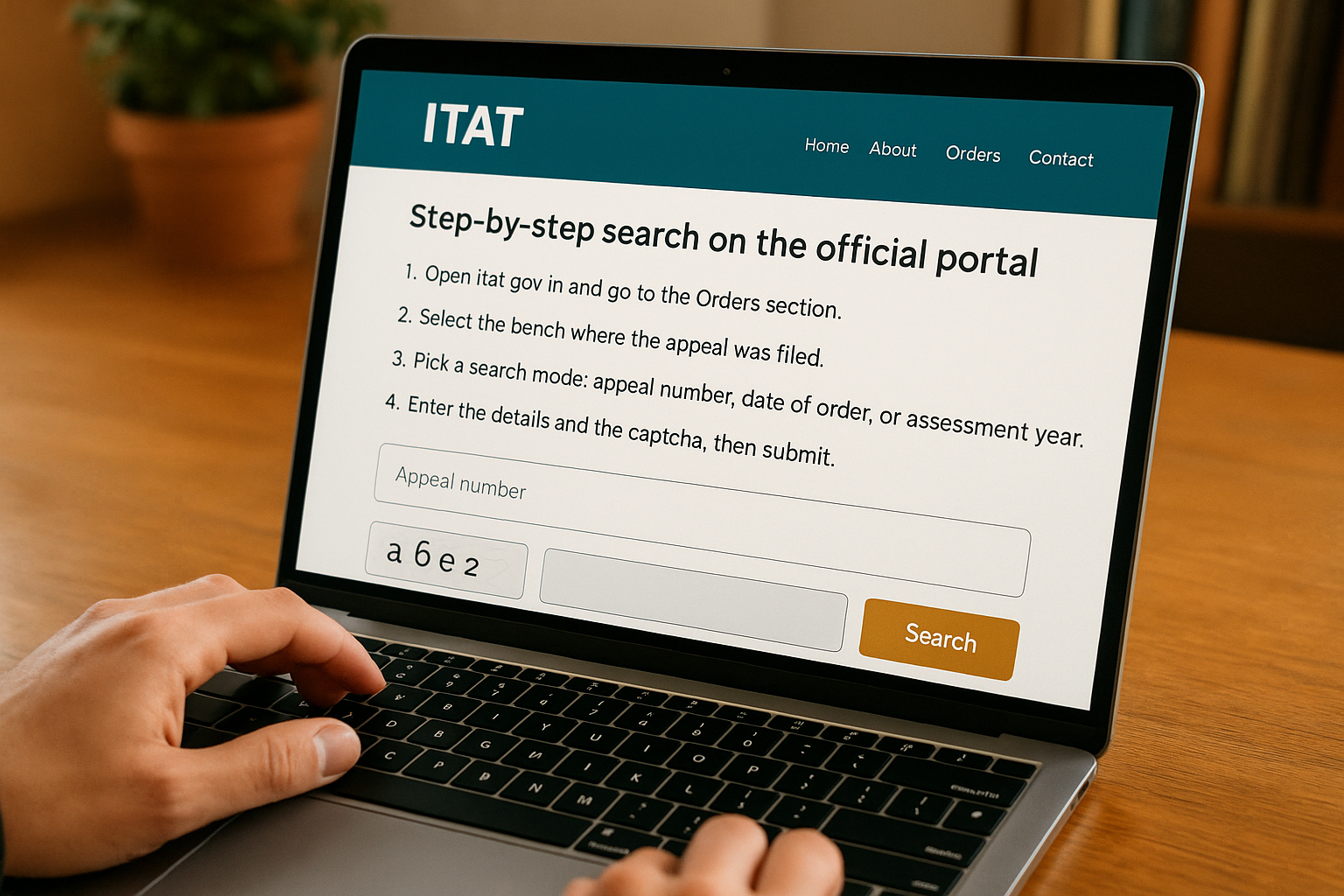
- Open itat.gov.in and go to the Orders section.
- Select the bench where the appeal was filed, for example Mumbai or Delhi.
- Pick a search mode: appeal number, date of order, or assessment year.
- Enter the details and the captcha, then submit.
- Open the result and save the PDF under a clear file name, such as the appeal number and date.
Date searches help when you remember only the approximate outcome. Use a narrow date range, because a wide range on a busy bench returns long result lists that are slow to scan.
How to write the appeal number
Most appeals follow a fixed pattern, for example ITA No. 1234/Del/2023. Enter each part as the portal asks, and do not repeat the bench code inside the serial number field. A wrong format is the commonest reason a known order does not appear.
| Part | Meaning |
|---|---|
| ITA | Appeal type. CO is a cross objection, SA a stay application, MA a miscellaneous application |
| 1234 | Serial number of the appeal |
| Del | Bench code, here Delhi |
| 2023 | Year the appeal was filed |
The year in the number is the year of filing, not the assessment year. People mix these up all the time, and the search then fails.
Search with the year the appeal was filed, not the assessment year.
What to do when the search returns nothing
Check the basics first. A wrong bench or year causes most failed searches, and a recent order may take a few days to appear after it is pronounced. Try the cross objection or miscellaneous application number as well, since the order you want may sit under a connected matter.
Then try another route. Search by assessee name or section in a private database, and match the appeal number back to the official portal. For a filing, cite the portal copy, and apply to the bench registry if you need a certified copy.
What an ITAT order contains and how to read it
Every Tribunal order follows a similar pattern, so you can read one quickly once you know the parts. The pattern also shows you which paragraphs deserve your time and which only recite what the lower authorities already said. Orders are pronounced in open court under Rule 34 of the Income-tax (Appellate Tribunal) Rules, 1963, and the written order is what you cite.
The parts of an ITAT order
Most orders move from the header to the result in the same sequence. The table shows what each part tells you.
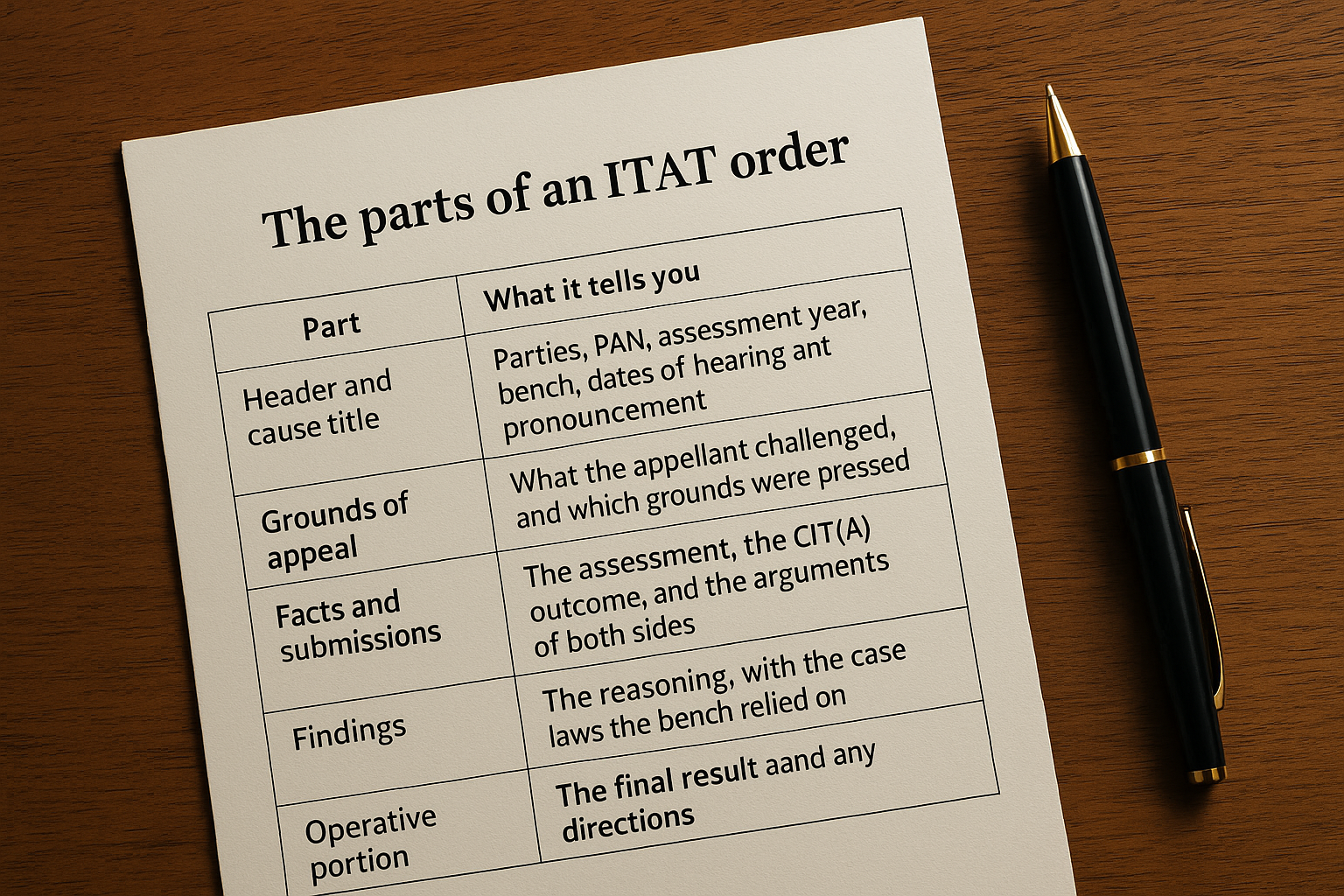
| Part | What it tells you |
|---|---|
| Header and cause title | Parties, PAN, assessment year, bench, dates of hearing and pronouncement |
| Grounds of appeal | What the appellant challenged, and which grounds were pressed |
| Facts and submissions | The assessment, the CIT(A) outcome, and the arguments of both sides |
| Findings | The reasoning, with the case laws the bench relied on |
| Operative portion | The final result and any directions |
Watch the wording of the result. Allowed means the assessee succeeded, and dismissed means the department or the assessee lost. Allowed for statistical purposes means the bench sent the issue back to the Assessing Officer, so the dispute is not finally decided yet.
How to read an order quickly
You do not need to read all forty pages in sequence. Use this order instead.
- Read the operative portion to learn who won.
- Read the facts to check whether they match yours.
- Find the ground that matches your issue and read the findings under it.
- Note every case law the bench relied on, and look each one up.
Read the result first, then the facts, and only then the reasoning.
The reasoning is where an order gains or loses value. Check whether the bench decided the question on merits or only on a technical point, such as limitation or a missing document. An order that turned on a procedural lapse says little about the law.
Finally, look for a later order in the same matter. A miscellaneous application under Section 254(2) can correct a mistake apparent from the record, and it must be filed within six months from the end of the month in which the order was passed. For long orders, an AI tool such as LeXi AI can condense the findings, but you should still verify the operative portion yourself.
How to use ITAT orders as precedent in your own matter
Using an order well means choosing the right one and presenting it honestly. A well-chosen order can shape how a bench sees your appeal. A badly chosen one costs you credibility in the first five minutes of the hearing.
Check that the facts and the law line up
Start with the ratio, not the headnote. The ratio is the reason the bench actually gave for its result, and remarks made in passing carry little weight. Test every order against your matter before you cite it:
- Does the same version of the provision apply to your assessment year? A Finance Act amendment can change the answer.
- Are the key documents similar, such as agreements, bank entries, or valuation reports?
- Did a High Court or the Supreme Court later reverse or distinguish the order?
- Does the High Court with jurisdiction over your bench take the same view?
Each assessment year is separate, yet the Supreme Court held in Radhasoami Satsang v. CIT (1992) 193 ITR 321 that consistency matters where the facts are the same. An earlier order for the same assessee on identical facts is therefore your strongest citation.
A Tribunal order helps you only when its facts, its law, and its later history all match yours.
Cite the order so the bench can find it
Give the appeal number, bench, assessment year, date of order, and the paragraph numbers you rely on. Copy the text from the official portal version and attach the full order to your paper book. The format below is illustrative.
XYZ Pvt. Ltd. v. DCIT, ITA No. 1234/Del/2023, AY 2018-19,
Delhi Bench, order dated 12.03.2025, paras 7 to 9
Deal with orders that go against you
Do not ignore a contrary order that you know about. Benches and departmental representatives search the same databases, and silence looks worse than an honest attempt to distinguish. Point to the differences in facts or documents, and explain why the reasoning does not apply.
Where coordinate benches have taken conflicting views, you can ask the bench to follow the better reasoned one. In a significant dispute, you may also request that the President constitute a Special Bench under Section 255(3). Whichever route you choose, keep your written note short, with the order, the ratio, and the point of difference in three lines each.
How to file an appeal and what happens after the order
Deadlines decide many Tribunal appeals before the merits are heard. You must use the correct form, pay the correct fee, and file on time. The same discipline applies after ITAT orders are passed, because a second set of limitation periods starts running.
How do you file an appeal before the ITAT?
Under Section 253(1), an assessee can appeal against most orders of the CIT(A), and the department can appeal on the direction of the Principal Commissioner or Commissioner. File the memorandum of appeal in Form 36 (Rule 47 of the Income-tax Rules, 1962) within 60 days of the date the order is communicated, as Section 253(3) requires. The Tribunal can condone a delay under Section 253(5) only for sufficient cause, so attach a short affidavit with specific dates.

The filing fee under Section 253(6) depends on the income assessed:
| Total income assessed by the AO | Fee |
|---|---|
| Up to Rs 1 lakh | Rs 500 |
| Above Rs 1 lakh, up to Rs 2 lakh | Rs 1,500 |
| Above Rs 2 lakh | 1% of assessed income, capped at Rs 10,000 |
| Matters not tied to assessed income | Rs 500 |
Cross objections run on a separate clock. A respondent who is unhappy with part of the CIT(A) order can file a memorandum in Form 36A within 30 days of receiving notice of the appeal. If the department is pressing for recovery, file a stay application with your appeal. Section 254(2A) allows a stay of up to 180 days, extendable to 365 days in total, though High Courts have read this limit differently.
What can you do after the order is passed?
Start with the operative portion, then count days. If the bench made a mistake apparent from the record, apply under Section 254(2) within six months. For a question of law, a further appeal lies to the High Court under Section 260A within 120 days of receiving the order, and it is admitted only on a substantial question of law.
Diary every deadline from the day the order reaches you, not the day you read it.
If the order goes your way, the Assessing Officer must still give effect to it. Section 153(5) allows three months from the end of the month in which the Commissioner receives the order. Follow up in writing, and claim interest on any refund under Section 244A. An order allowed for statistical purposes is different, because you will face a fresh hearing before the Assessing Officer.
Other databases and tools for finding ITAT case law
Where else can you search for ITAT judgments?
The official portal works best when you already know the appeal number. It is weaker when you only know the issue. For issue-based research, private databases let you search by section, keyword, or assessee name, and many add headnotes and notes on later history. The table compares the usual options.
| Source | Best for | Watch out for |
|---|---|---|
| Official ITAT portal | Citing an exact order by appeal number | Limited search by issue |
| High Court and Supreme Court websites | Appeals against ITAT orders and binding rulings | Each site uses a different search format |
| Subscription tax databases | Searching by section, issue, or keyword | Headnotes can miss key facts |
| AI research tools | Finding related orders and summarizing them | Every citation needs checking |
AI tools save the most time when the issue matters more than the appeal number. LeXi Agent supports legal research and precedent analysis with verified sources. Treat its output as a lead to follow, not as an authority to cite. You still open the original order before it goes into your submissions.
A practical routine for combining them
No single source gives you everything, so use them in a fixed order. This routine keeps your research fast and your citations safe.
- Search by section or issue in a database or AI tool to build a list of candidate ITAT orders.
- Note the appeal number, bench, and date of each candidate.
- Download each order from the official portal and read the facts paragraph first.
- Check the High Court website for any appeal under Section 260A against the order.
Step four is the one people skip. An order that looks favorable may have been reversed or set aside months later, and a private headnote will not always say so.
Find an order anywhere, but confirm it on the official portal before you cite it.
Keep a simple log with the appeal number, the paragraph you rely on, and the date you last checked its status. A short log helps when a bench asks where you found a ruling, and it stops you from citing a stale order in a later matter.
Keeping your ITAT research reliable
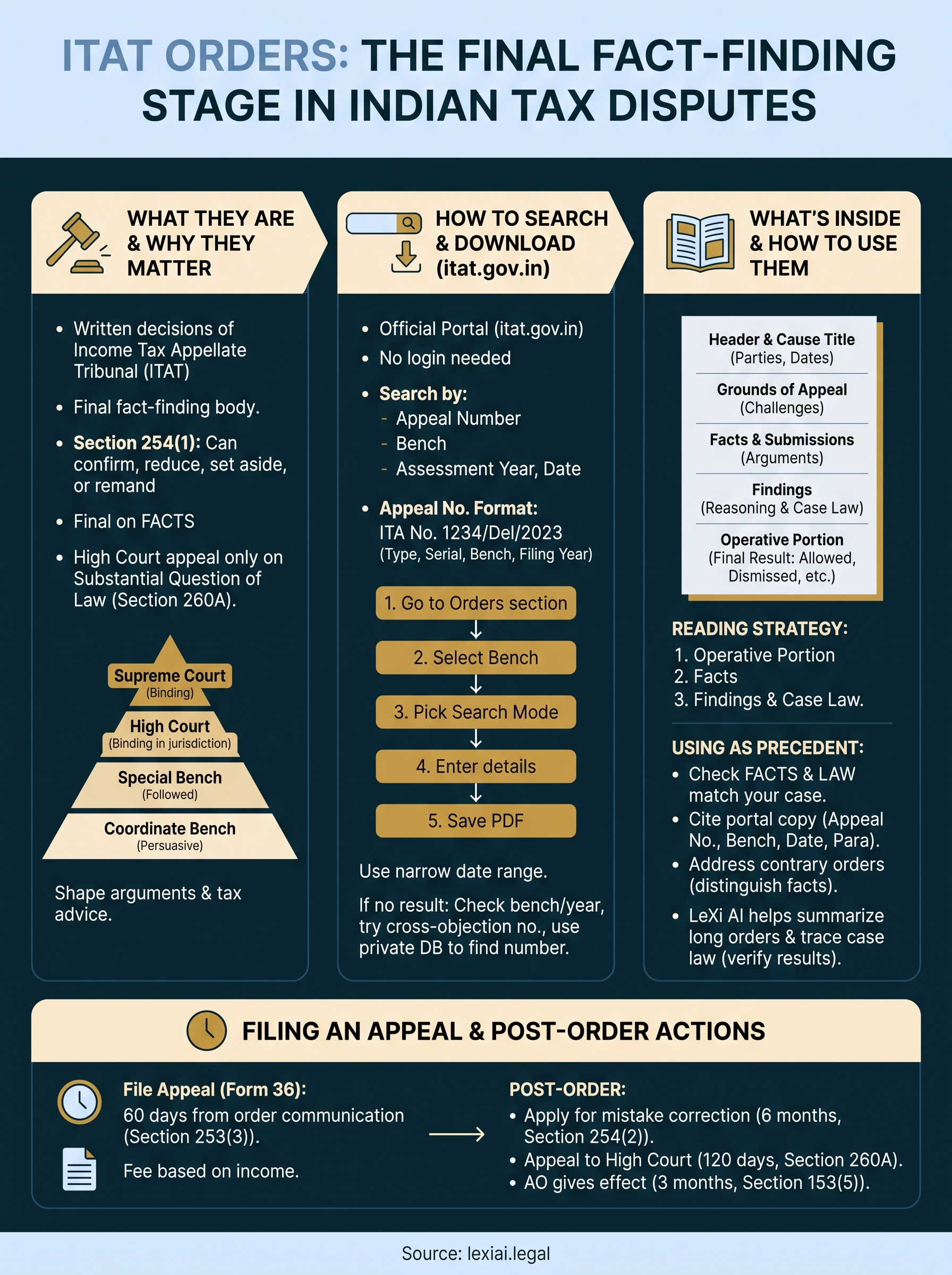
Reliable research on ITAT orders comes down to a few habits. Find the order by any route, but confirm it on the official portal before you cite it. Then read the facts first, check the operative portion, and look for a later High Court ruling under Section 260A.
Next, keep a short research log with the appeal number, the paragraph you rely on, and the date you last checked its status. It protects you from stale citations. It also saves time when a bench asks where a ruling came from.
Finally, use tools for speed and your own judgment for accuracy. If you want help with summarizing long orders and tracing related case law, test LeXi AI free on your next ITAT matter, and verify every result against the original order.