

Appointment Letter Format: Sample and How to Draft One
An appointment letter format is the standard structure employers use to confirm a job offer in writing, covering designation, salary, joining date, probation period, and termination notice. It works as a binding employment document once the candidate signs and returns it, so getting the clauses right matters more than most HR teams realize. Get the format wrong and you risk disputes over notice periods or termination terms later, sometimes tested under the Industrial Employment (Standing Orders) Act, 1946.
If you searched for this term, you likely want a ready sample template you can adapt today, not a theory lesson on labor law. This guide gives you exactly that, a clause-by-clause breakdown paired with a usable draft you can fill in within minutes for any role, from an associate advocate to a corporate manager.
Below, you will find the essential sections every appointment letter needs, a complete sample format, and a step-by-step process for drafting your own. If you draft appointment letters often, tools like LeXi Desk can generate and check clauses for risk before you send them out.
What an appointment letter must legally include
Every appointment letter you issue in India sits somewhere between a private contract and a document courts will read against the Indian Contract Act, 1872, and, for workmen, the Industrial Employment (Standing Orders) Act, 1946. A legally sound appointment letter format spells out designation, compensation, place of posting, notice period, and grounds for termination in plain terms, because ambiguity here almost always favors the employee in a labor dispute. Skip a clause and you are not saving time, you are handing a future arbitrator or labor commissioner room to interpret the gap however they see fit.
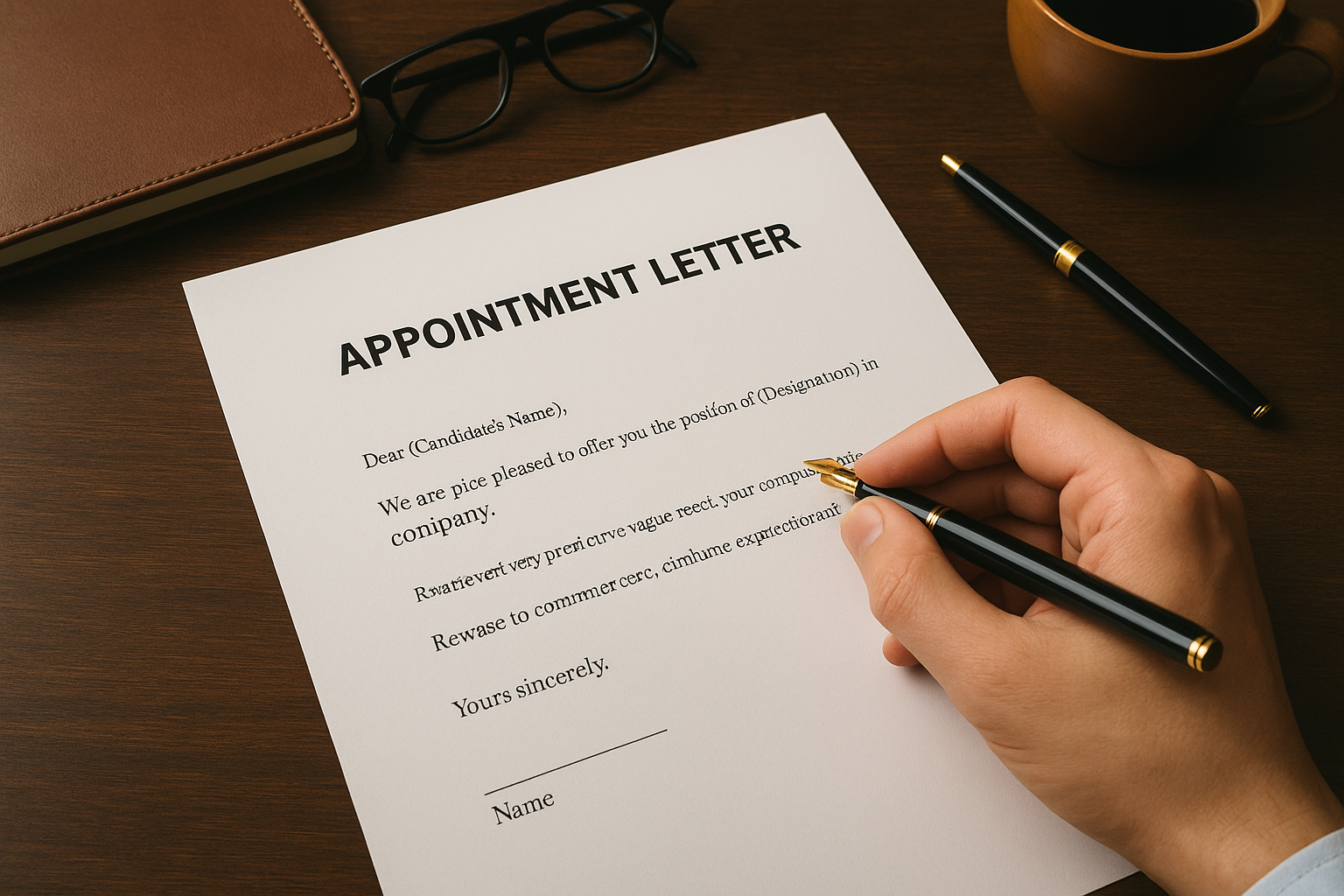
An appointment letter with a missing clause is not incomplete paperwork, it is an open invitation to a dispute you will lose on technicality.
Clauses no appointment letter can skip
Most disputes over appointment letters in India trace back to one of six clauses, either because they were vague or missing entirely. Reviewing thousands of contracts through clause risk analysis tools shows the same gaps repeating across sectors, from law firms hiring associates to manufacturing units hiring supervisors.
| Clause | What it must state | Legal basis |
|---|---|---|
| Designation and role | Exact title, reporting manager, work location | Indian Contract Act, 1872, Section 10 |
| Compensation | CTC breakup, payment date, deductions | Payment of Wages Act, 1936 |
| Probation period | Duration, confirmation criteria | State Shops and Establishments Acts |
| Notice period | Days required from both sides | Industrial Employment (Standing Orders) Act, 1946 |
| Termination grounds | Misconduct, poor performance, redundancy | Industrial Disputes Act, 1947 (for workmen) |
| Confidentiality and IP | Ownership of work product, non-disclosure scope | Indian Contract Act, 1872, Section 27 (restraint clauses, read narrowly) |
Once these six sit in your standard appointment letter format, you have covered the clauses Indian labor commissioners and civil courts check first when a dismissed employee challenges an exit.
State-specific requirements you cannot ignore
Because India regulates employment partly at the state level, your appointment letter format needs a state-specific check before you finalize it. Maharashtra, Karnataka, and Delhi each have their own Shops and Establishments rules governing working hours, weekly offs, and minimum notice periods, and these override a generic template drafted for a different state.
Without that check, you risk issuing a job appointment letter format that looks complete but violates a state rule the moment an employee raises a grievance. A quick way to stay safe: pull the relevant state Act before you finalize your master template, and revisit it whenever you open a new office location.
Once these fundamentals are locked in, you can move to filling in the actual details, starting with the company, candidate, and role information that opens every letter.
Step 1. Add company, candidate, and role details
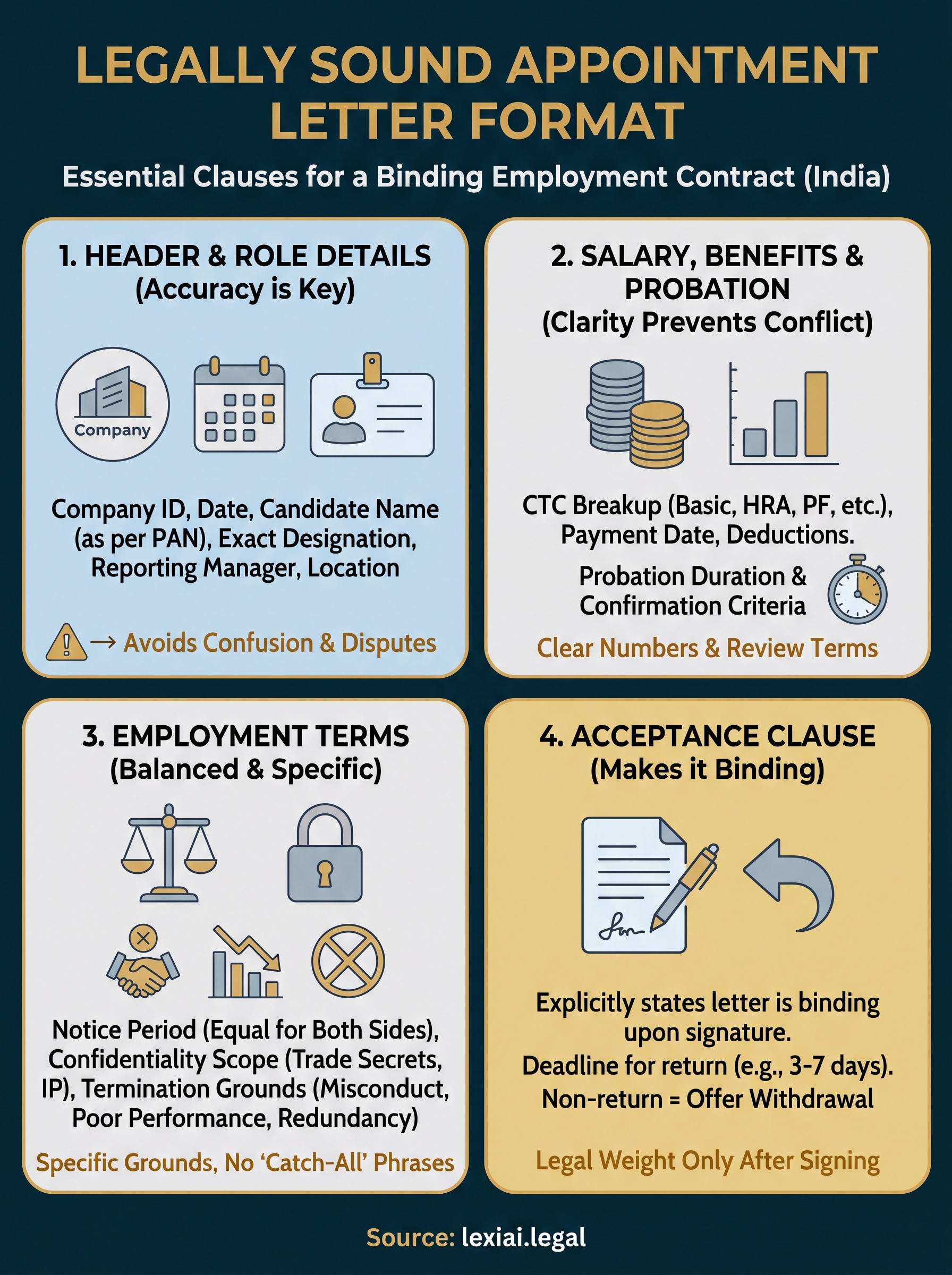
Start drafting from the top of the page down, because the header details are what a candidate checks first to confirm the letter is genuine. Get the company identification wrong, a mismatched CIN, an old address, a signatory who no longer holds that title, and you have handed the candidate a reason to question everything else in the document. This is also the section where you fix the exact designation, so there is no confusion later about whether someone was hired as "Associate" or "Senior Associate."
Header details that identify the letter
Begin with the company letterhead, a reference number, and the date of issue, since these three anchor the document for audit trails and future reference. Follow this with the candidate's full legal name exactly as it appears on their PAN card, because a name mismatch causes real friction during onboarding and provident fund registration.
A letter that gets the candidate's name or designation wrong before it even reaches the salary clause rarely gets read carefully after that.
Role and reporting line specifics
Next comes the role block, and this is where vague language creates problems months later when a manager assigns work outside the stated job description. Specify the exact designation, the department, the reporting manager's name and title, and the primary work location, since courts and labor commissioners treat this section as evidence of what both sides originally agreed to.
[Company Name]
[Registered Address]
Ref: [Letter Number] | Date: [DD/MM/YYYY]

Dear [Candidate Full Name],

We are pleased to appoint you as [Designation] in the
[Department] at our [City/Branch] office, reporting to
[Manager Name, Title], effective [Joining Date].
Fill in every bracket before you move on, since an appointment letter template with placeholder text still in it is one of the fastest ways to lose credibility with a new hire on day one. Once the role details are locked, you are ready to move to the section candidates read most carefully: salary, benefits, and probation terms.
Step 2. Specify salary, benefits, and probation terms
Salary is where a candidate reads the closest, so vague numbers here cause more disputes than almost any other clause. State the CTC breakup in full, basic pay, HRA, special allowance, employer PF contribution, and any variable pay, rather than a single lump figure that leaves deductions open to interpretation later. Payment of Wages Act, 1936 requires clarity on payment dates and permissible deductions, so name the exact date salary gets credited each month and list what gets deducted before that.
A salary clause with only a CTC number and no breakup is not simplicity, it is a dispute waiting for a payslip to expose it.
Benefits and probation duration
Beyond salary, list the benefits that carry monetary or legal weight: gratuity eligibility, provident fund enrollment, medical insurance, and leave entitlement under the applicable state Shops and Establishments Act. Follow this with the probation period clause, stating the exact duration (commonly three to six months for most roles, up to a year for senior positions) and the criteria for confirmation, since an open-ended probation clause without a review date is one of the most common gaps flagged during clause risk analysis.
Your annual CTC is [Amount], comprising:
- Basic Pay: [Amount]
- HRA: [Amount]
- Special Allowance: [Amount]
- Employer PF Contribution: [Amount]

Salary is credited on the [Date] of each month, subject to
statutory deductions.

You will be on probation for [Duration] from your joining
date, subject to confirmation based on performance review.
Why probation terms get challenged most
Probation clauses draw the most legal scrutiny because employers often extend probation informally without documenting it, which weakens their position if they later terminate someone during an extended, undocumented period. Fix this by adding one line stating how probation can be extended and for how long, so the appointment letter format you issue holds up if a probationary employee's exit gets challenged before a labor court. Once salary and probation are settled, move to the broader employment terms and the acceptance clause that make the letter enforceable.
Step 3. Add employment terms and an acceptance clause
Every appointment letter needs a section covering notice period, confidentiality, and termination grounds before it closes, because these clauses decide what happens if either side wants to exit. State the notice period in days for both employer and employee, since an asymmetric notice period, say thirty days from the employee but immediate termination rights for the employer, gets struck down as one-sided under Section 23 of the Indian Contract Act, 1872 in many state courts. Add a confidentiality clause that covers client data, trade secrets, and work product ownership, keeping restraint language narrow so it does not fall foul of Section 27 on restraint of trade.
A notice period that only binds the employee, not the employer, is the clause most likely to get thrown out the moment it is challenged.
Termination grounds and dispute resolution
List specific grounds for termination, misconduct, poor performance after documented warnings, and redundancy, rather than a catch-all phrase like "at management's discretion." Courts and labor commissioners read vague termination language as evidence the employer never actually defined the standard, which weakens your position in any Industrial Disputes Act, 1947 proceeding. Close this section with a jurisdiction clause naming the city where disputes get resolved, since this saves both sides from arguing venue after a dispute has already started.
The acceptance clause that makes it binding
An appointment letter has no legal weight until the candidate signs and returns a copy, so the acceptance clause must say so explicitly. Ask for a signed copy within a stated window, typically three to seven days, and treat non-return as grounds to withdraw the offer.
Your notice period is [Days] from either side. This offer is
subject to the laws of India, with disputes referred to courts
in [City].

Please sign and return a copy of this letter within [X] days
to confirm your acceptance of the above terms.

Signature: ____________________
Date: ____________________
With these three sections drafted, header, compensation, and terms with acceptance, you have a complete appointment letter format ready to adapt for any role.
Sample appointment letter formats for common roles
A single appointment letter template rarely fits every hire. A litigation associate needs different confidentiality language than a corporate manager, and a law student intern needs a stipend clause instead of a CTC breakup. Adjust the clauses you learned above to match the role, rather than forcing one master draft onto every designation.

The same six clauses apply everywhere, but the wording inside each one changes with the role.
Comparing clauses across common roles
Before you draft, check how probation, notice, and confidentiality scope typically shift by role. This table gives you a starting benchmark, not a fixed rule, since firm policy and state law can push these numbers either way.
| Role | Typical probation | Notice period | Confidentiality scope |
|---|---|---|---|
| Associate advocate | 3 months | 30 days both sides | Client matters, case strategy |
| Corporate manager | 6 months | 60 days both sides | Trade secrets, financial data |
| Law student intern | None (fixed term) | 7 days | Case files, client names |
Associate advocate appointment letter snippet
Carry the standard header and salary blocks from earlier, then swap in litigation-specific confidentiality language, since a law firm hire touches client matters that a corporate role never sees.
You will maintain strict confidentiality over all client
matters, case strategy, and privileged communications
accessed during your engagement with the firm, both during
and after your tenure.
Corporate manager appointment letter snippet
Drop in a broader clause covering trade secrets and reporting lines, since a manager role usually carries budget authority and access to financial data that a junior hire does not.
You will report to [Designation], manage a team of [Number],
and hold signing authority up to [Amount] as defined in the
company's delegation of authority policy.
Once you have the base draft, run it through a tool built for legal drafting, such as LeXi Desk, to check clause risk before you send the final version to a candidate.
Getting the format right the first time
A correct appointment letter format protects both sides before any dispute even starts. Get the six core clauses right, designation, compensation, probation, notice, termination grounds, and acceptance, and you close off the gaps that labor commissioners and courts exploit first. Every role still needs its own adjustments, but the underlying structure stays the same whether you are hiring an associate advocate or a corporate manager.
Before you send your next offer, run the draft past someone who checks clause risk for a living, not just spelling and formatting. Manual review misses the same gaps repeatedly, an open-ended probation clause here, an asymmetric notice period there. If you draft appointment letters regularly, try LeXi Desk to generate compliant clauses and flag risky language before a candidate ever sees the letter, so the format holds up the first time, not just on paper.